What to check when new strings break within a few hours
The break location helps distinguish normal spin-related wear from grommet or clamp damage.
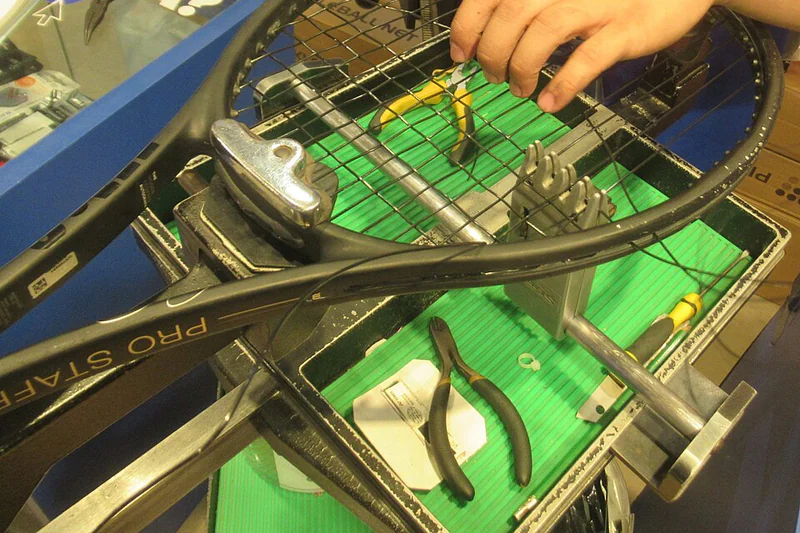
Start with this check
When notching deepens and a string then breaks at an intersection in the center of the usual contact zone, accumulated ball impact and string-to-string friction are a reasonable normal-wear hypothesis. When early breakage recurs at a knot, grommet hole, frame edge, or clamp-contact point, inspect damaged parts and evidence from the stringing job instead of blaming only string durability. One severe off-center impact or contact with something other than a ball can also be responsible, so preserve both the moment and the location of the break.
Try these steps in order
- Before cutting out the strings, photograph the complete front and back of the racquet and the broken end close up. Note which main or cross it is counting from the center, whether the break lies inside or outside the frame, and whether it happened while hitting or in storage. For a center break, inspect the direction and depth of notching at nearby intersections. A cleanly severed single strand versus fraying accumulated at several points can help show whether wear built gradually.
- Near the frame, visually inspect whether the grommet is cracked or sunken and whether a sharp frame edge is exposed. Do not put a finger or metal tool into the hole; show the photograph and racquet to a stringer. Ask the stringer to inspect knot locations, clamp marks, and recent grommet or bumper replacement. If a string breaks twice at the same point, record the suspected cause and corrective action on a receipt or log before installing another set.
- Only after concluding that the break is normal center wear should you test one change: the same product one gauge thicker, a more durable material, or a hybrid. Keep the racquet, reference tension, and stringer constant, and measure both time to breakage and time for which the desired response remains. A setup that lasts longer is not successful if trajectory or feel misses the target. Adopt it when three records show a consistently central break location and longer useful life; if edge breakage recurs, return to inspecting the parts.
Bottom line
The key evidence in early breakage is not product reputation but the break coordinates, surrounding marks, and recurrence pattern. Separate normal center wear from a frame-side problem before changing gauge or material so that added expense does not hide the cause.
TENNIS TENSION LAB
Check your racquet’s tension today.
Get a high-precision tension reading in under 10 seconds. Tension Lab tracks changes from your first reading and helps you see when to restring.
- High-precision tension measurement. Ready in under 10 seconds.
- Track every change in feel. See the full story over time.
- Time to restring? Never leave it to guesswork.
Reviewed sources
Technical evidence is shown separately from community topic signals.