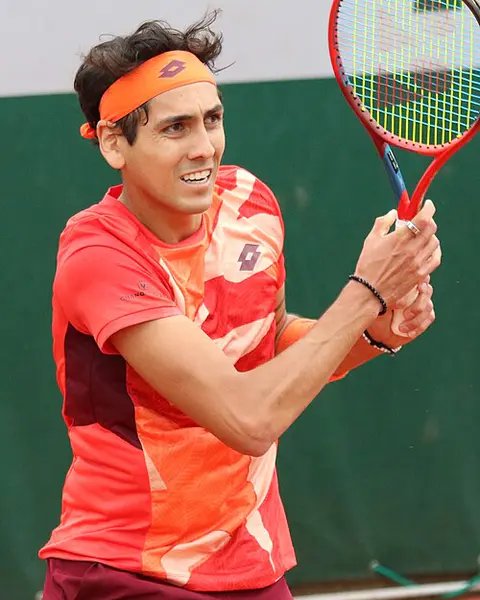
ATP · Active · Chile
Alejandro Tabilo
ATP#28Ranking as of 2026-08-24
Career-high ranking: 19
Alejandro Tabilo: the same score, different tests on clay and grass
Alejandro Tabilo is 188 cm tall. His 2024 Rome quarterfinal and Mallorca final both ended 6–3, 6–4, but their reports reveal different things about serving, pressure and interpreting surface results.
- Status
- Active
- Age
- Age 29
- Height
- 188 cm
- Playing hand
- Left-handed
- Tour wins
- 89 / 174
- Tour titles
- 3
- Grand Slam titles
- 0
- Career win rate
- 51.1%
Auckland, Rome and Mallorca asked different questions
Tabilo came through qualifying to win his first ATP singles title on the hard courts of Auckland in 2024. On clay in Rome he defeated then-world No. 1 Novak Djokovic and reached his first Masters 1000 semifinal. He subsequently won the grass-court title in Mallorca. Those three runs are a useful starting point for understanding his range of results.
Auckland and Mallorca titles and a Rome semifinal involved different event categories and draws. Before deciding which surface suits him best, consider the number of matches and the opponents. A qualifier and a seeded player receiving a bye also face different routes through a tournament.
Rome: what a held service game tells you—and what it does not
TENNIS.com’s 15 May 2024 report records Tabilo beating Zhang Zhizhen 6–3, 6–4 in 87 minutes in the Rome quarterfinals, holding serve throughout. He had reached that point without dropping a set, with wins over Novak Djokovic and Karen Khachanov earlier in the draw. Those are specific results from the run; the final score alone would not show how consistently he protected his service games.
In the accompanying interview, Tabilo linked his improving serve to allowing his arm to move more freely and committing to the shot. He also said his composed appearance concealed nerves. This is his account of that week, not a biomechanical measurement or proof that calm body language means low pressure. Holding every service game likewise does not tell you his first-serve percentage or whether he faced break points; those require separate records.
Mallorca: the same 6–3, 6–4, with different evidence
The Associated Press report carried by ESPN on 29 June 2024 records Tabilo defeating Sebastian Ofner 6–3, 6–4 in the Mallorca final. It specifies one break in each set and all 3 break points saved on his own serve. Here the report supplies the pressure count that the score cannot. Saving 3 out of 3 describes this match, not an estimate of his long-term chance of escaping a break point.
Mallorca was his second tour singles title of 2024, after Auckland, and the report identifies the grass title as an Open-era first for a Chilean man. Keep that singles-tour context: it is not a claim about every level of tennis. Rome was a clay quarterfinal and Mallorca a grass final against a different opponent. Matching scores do not make the conditions, return quality or difficulty interchangeable.
Watch the left-handed serve with the next forehand
Tabilo is left-handed and uses a two-handed backhand. A left-hander’s wide serve from the ad court can open the court towards a right-handed receiver’s backhand. The useful question is where the server meets the next forehand when the return comes back.
If the receiver begins anticipating the wide serve, the body and centre targets acquire a different purpose. Watch the return position and the next two shots as a sequence rather than collecting successful serves by direction. Handedness alone does not establish how frequently a player uses a pattern or how effective it is.
Birthplace, representation and equipment are separate facts
Born in Toronto, Canada, on 2 June 1997, Tabilo represents Chile. Keeping birthplace separate from sporting representation avoids a common source of confusion. His published height is 188 cm.
Equipment claims need a model, an observation date and a source. A tension mentioned in a general profile is not necessarily used at every subsequent event. String model, gauge, stringing method and conditions can all change the comparison. An undocumented number should not become a personalised recommendation.
Build a comparison before deciding which surface suits a player
With complete match video, take a fixed sample of service points from each match, rather than a selection of highlights. Record whether the first serve landed, whether the return came back, the server’s position for the next shot and how the point ended. State the number of points observed alongside any percentage. Keep opponent and surface labels attached to each sample.
Compare like situations, such as points begun with a second serve, before attributing a difference to clay or grass. A change may come from the receiver, the serve target or a small sample rather than the court alone. This is a reader’s analysis worksheet, not a set of new Tabilo statistics or his training programme. If the full points are unavailable, retain the published match facts instead of filling the gaps from a highlight reel.
Results by surface
Read each win rate together with its recorded match sample.
- Hard
- 46.3%82 matches
- Clay
- 55.1%78 matches
- Grass
- 57.1%14 matches
Career timeline by age
· Age 22
First recorded tour match
The first main-draw tour match covered by the current data set.· Age 26
First tour title
A verified tour-title milestone in this player’s career.· Age 27
Career-high ranking: No. 19
The highest position found in the available weekly singles rankings.· Age 28
Most recent recorded match
The latest tour match included in the current snapshot.
Reviewed sources
A result-based profile built from surface results, rankings, titles, and playing hand. Missing shot-speed, spin-rate, and point-pattern data are not invented.
Player reference page ↗Players to explore next
 Tomas Barrios VeraChile · 2017–2026Career-high ranking: 93
 Nicolas JarryChile · 2013–2026Career-high ranking: 16
 Cristian GarinChile · 2012–2026Career-high ranking: 17
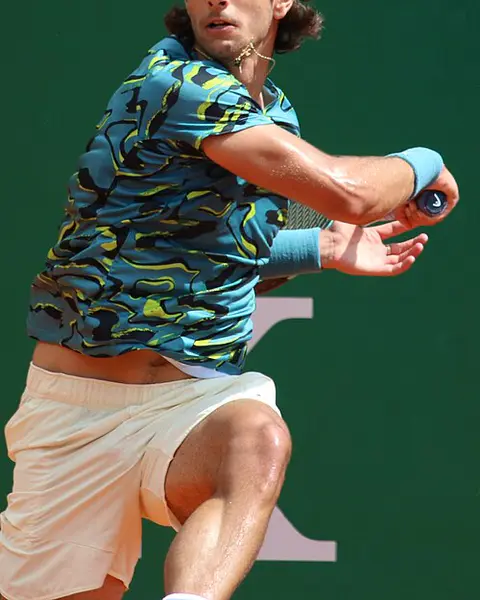 Lorenzo MusettiItaly · 2020–2026Career-high ranking: 5
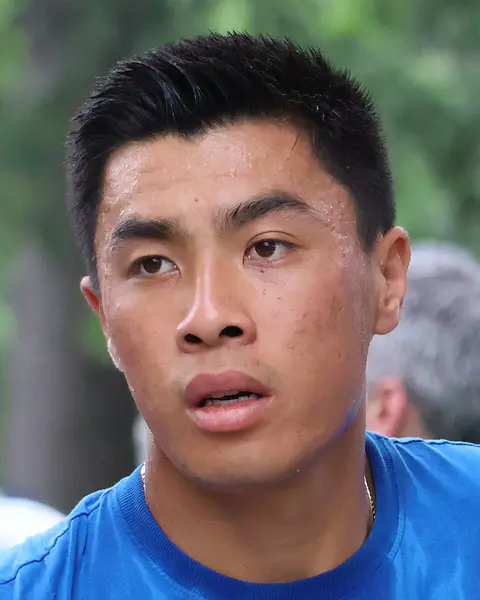 Brandon NakashimaUnited States · 2020–2026Career-high ranking: 29
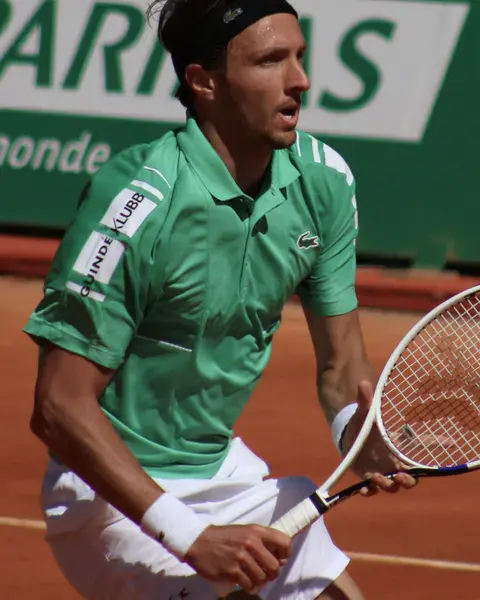 Arthur RinderknechFrance · 2020–2026Career-high ranking: 24
TENNIS TENSION LAB
Check your racquet’s tension today.
Get a high-precision tension reading in under 10 seconds. Tension Lab tracks changes from your first reading and helps you see when to restring.
- High-precision tension measurement. Ready in under 10 seconds.
- Track every change in feel. See the full story over time.
- Time to restring? Never leave it to guesswork.