
WTA · Active · Philippines
Alexandra Eala
WTA#18Ranking as of 2026-08-24
Career-high ranking: 18
Alexandra Eala: 175 cm and the return pressure behind her Miami breakthrough
Eala’s verified height is 175 cm. Her 2025 Miami run offers a detailed lesson in early returns, repeated breaks and the work still needed to protect a lead on serve.
- Status
- Active
- Age
- Age 21
- Height
- 175 cm
- Playing hand
- Left-handed
- Tour wins
- 32 / 72
- Tour titles
- 1
- Grand Slam titles
- 0
- Career win rate
- 44.4%
Start with the verified height
Alexandra Eala was born in Quezon City, Philippines, on 23 May 2005. Her official WTA profile lists her at 175 cm; she plays left-handed with a two-handed backhand. Alexandra Eala and Alex Eala refer to the same player.
Height helps frame serve contact and reach, but does not measure return timing or the ability to use incoming pace. Watch her distance from the baseline and preparation at the opponent’s contact, rather than treating height as an explanation of those skills.
Four played wins, plus a walkover
Eala arrived in Miami in 2025 ranked No. 140 with a wildcard and a 2–14 career record in tour-level matches. She then beat Katie Volynets, Jeļena Ostapenko, Madison Keys and Iga Świątek to reach the semifinals. Paula Badosa withdrew before their round-of-16 match, giving Eala a walkover. Counting four played wins preserves the distinction between a draw advance and a match victory.
Ostapenko, Keys and Świątek were ranked No. 25, No. 5 and No. 2 at that event. Eala beat all three major champions in straight sets, but the scorelines conceal different problems. She recovered from 0–4 in the opening set against Ostapenko to win 7–6(2), 7–5, then beat Keys 6–4, 6–2. The Świątek quarterfinal supplied another recovery inside a set. This was a sequence of different tests, rather than one result repeated against three names.
Świątek: eight breaks, but no uninterrupted lead
Eala won the quarterfinal 6–2, 7–5 on 26 March 2025. David Kane’s contemporary report records four breaks of Świątek’s serve in the opening set and 19 Świątek unforced errors in that set. Steve Tignor’s analysis reports eight breaks across the match and Eala winning 80% of points on Świątek’s second serve. That percentage concerns one opponent’s second-service points in one match, not Eala’s overall return success rate.
In the second set Eala led 2–0, lost four games in a row, then recovered from 2–4. Świątek also failed to serve out the set at 5–4, and Eala eventually closed it 7–5. The final straight-set score therefore contains both a lost lead and a recovery. Eight breaks explain the pressure applied on return; they do not establish that Eala was equally secure on her own service games.
The useful replay comparison is between those two roles. On return, examine how early contact and the direction of the reply restrict the server’s next ball. On serve, examine whether the first delivery earns an attack or leaves Eala defending immediately. Record where the next contact happens: a player pushed back or stretched wide faces different options from one able to step inside the baseline. That is how return pressure becomes a point-by-point question.
Early contact is a timing choice, not a command to stand closer
Tignor’s analysis describes Eala working near the baseline, taking the ball on the rise, attacking second serves and using her forehand down the line. Meeting the ball before it travels farther back and changing its direction can leave an opponent less time to prepare. The timing advantage depends on the incoming ball and on how cleanly the returner can make contact; the forward position has to work together with preparation.
For a player trying this idea, moving forward is only one part of it. Preparation must finish earlier too. A return contacted late beside the body may leave fewer options despite the advanced position. Keep the target generous and compare the next ball you receive: did the server have to hit from discomfort, or could they attack immediately? A down-the-line return is useful when its direction and your recovery fit the situation, not simply because it looks more aggressive.
A WTA 125 title and a first tour title are different
Eala reached her first WTA Tour singles final in Eastbourne in 2025 and won a WTA 125 title in Guadalajara that year. Her Washington victory in 2026 was a WTA 500 title and her first WTA Tour singles championship. An earlier WTA 125 trophy does not contradict the first-tour-title description.
She reached a career-high singles ranking of No. 18 on 24 August 2026. An undated description of her as the world No. 18 will not remain accurate indefinitely. Keep that career-best record separate from the publication date of the ranking snapshot on this page.
Read the left-handed return through the next exchange
A left-hander’s forehand and backhand occupy the opposite sides from a right-hander’s. Note the return target and which wing is likely to receive the first rally ball. An identical crosscourt target can create different next-shot choices depending on serve placement and recovery.
In practice, use a broad central target beyond the service line. Record how often you handle the server’s next attack and stay in the point, rather than measuring return pace alone. Then vary the starting position while retaining the target. This is an exercise for understanding return geometry, not a claim about Eala’s personal routine.
Results by surface
Read each win rate together with its recorded match sample.
- Hard
- 45.7%46 matches
- Clay
- 36.8%19 matches
- Grass
- 57.1%7 matches
Career timeline by age
· Age 16
First recorded tour match
The first main-draw tour match covered by the current data set.· Age 21
Most recent recorded match
The latest tour match included in the current snapshot.· Age 21
Career-high ranking: No. 18
The highest position found in the available weekly singles rankings.
Reviewed sources
A result-based profile built from surface results, rankings, titles, and playing hand. Missing shot-speed, spin-rate, and point-pattern data are not invented.
Player reference page ↗Players to explore next
 Qinwen ZhengChina · 2021–2026Career-high ranking: 4
 Cristina BucsaSpain · 2021–2026Career-high ranking: 30
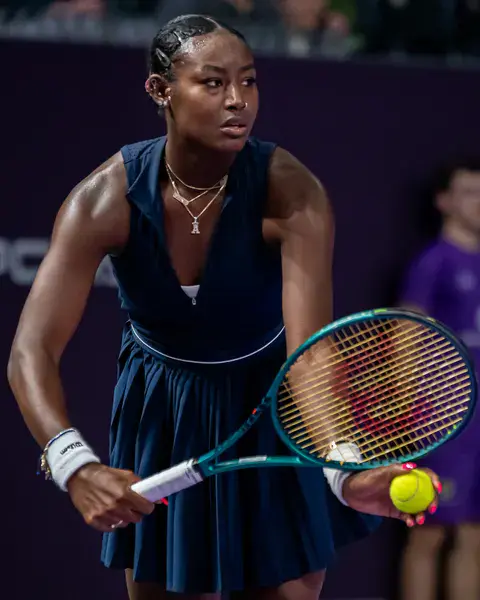 Alycia ParksUnited States · 2021–2026Career-high ranking: 40
 Ashlyn KruegerUnited States · 2021–2026Career-high ranking: 29
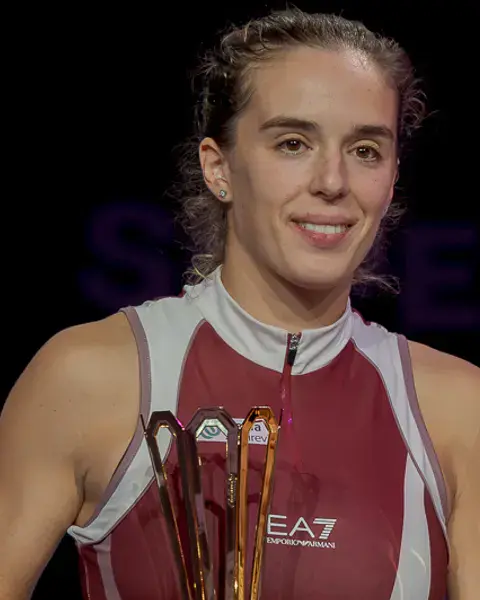 Lucia BronzettiItaly · 2021–2026Career-high ranking: 46
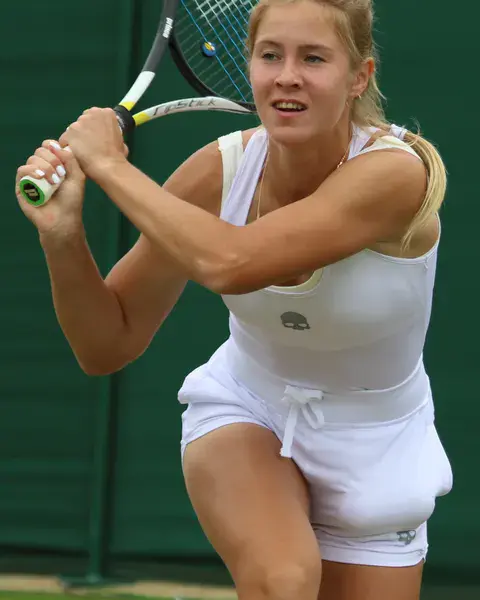 Anastasia ZakharovaRussia · 2021–2026Career-high ranking: 65
TENNIS TENSION LAB
Check your racquet’s tension today.
Get a high-precision tension reading in under 10 seconds. Tension Lab tracks changes from your first reading and helps you see when to restring.
- High-precision tension measurement. Ready in under 10 seconds.
- Track every change in feel. See the full story over time.
- Time to restring? Never leave it to guesswork.