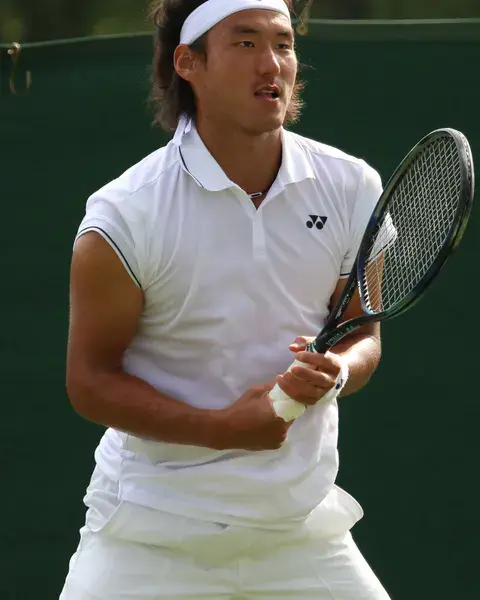
ATP · Active · China
Bu Yunchaokete
Career-high ranking: 64
Bu Yunchaokete: a closing service game and a tiebreak tell different stories
Bu Yunchaokete is 185 cm tall. His career-high ATP ranking and the official 2024 Beijing reports provide a starting point for understanding how he closed out Rublev and where his challenge to Sinner turned.
- Status
- Active
- Age
- Age 24
- Height
- 185 cm
- Playing hand
- Right-handed
- Tour wins
- 23 / 60
- Tour titles
- 0
- Grand Slam titles
- 0
- Career win rate
- 38.3%
One player, different name orders
Bu Yunchaokete and Yunchaokete Bu refer to the same player. Buyunchaokete is a Mongolian given name, so treating the first part as a conventional family name can mislead. His Chinese name is 布云朝克特. Birth date and sporting representation help connect records that reverse the displayed order.
Born on 19 January 2002, Bu has a published height of 185 cm. His career-high ATP singles ranking is No. 64, reached on 14 April 2025. A career high is not this week’s position: check the publication date before using a ranking result to assess his present standing.
What the Seoul title tells us
His first Challenger title came in Seoul in 2023, with Aleksandar Vukic the opponent in the final. He added Challenger titles in Wuxi and Granby in 2024. Challenger events sit below the main ATP Tour; those trophies should not be included in a tour-level singles title total.
Entry routes matter during this transition. A player may arrive through qualifying, a wildcard or direct acceptance. Two main-draw semifinal runs can involve different numbers of matches and recovery periods, so the final round reached does not tell the whole workload story.
Rublev: the break mattered, but the closing hold completed it
Bu’s 2024 Hangzhou semifinal was followed by another in Beijing, an ATP 500 event. After wins over Shang Juncheng and Lorenzo Musetti, he beat Andrey Rublev for his first top-10 victory. The China Open report identifies Rublev as world No. 6 and the fourth seed—the world ranking and tournament seeding for that week, respectively. Bu had entered Beijing with a wild card.
The official account describes ten holds to open the quarterfinal, followed by Bu’s break in the eleventh game and a love hold to take the set 7–5. In the second set he broke in the third game, but serving at 5–4 he fell behind 30–40. He won the final three points to close 7–5, 6–4. The value of the earlier break depended on protecting this last service game; the report gives a concrete pressure situation, not merely a straight-sets result.
Rublev had also completed his rain-delayed match against Alejandro Davidovich Fokina that morning. That scheduling difference belongs in the comparison, without being treated as proof that fatigue decided the quarterfinal. Bu’s own account says he felt more pressure in the closing game. Watch the serve, the first playable reply and the recovery together when reviewing such a game: taking the lead and holding it can ask different questions.
Sinner: a set of holds can still turn in four points
Bu then lost the semifinal to Jannik Sinner 3–6, 6–7(3). The tournament report describes a first set in which the fifth game went to six deuces; the first five games took 32 minutes. Sinner held that game and broke in the sixth. Those two games help explain the opening set better than the final 6–3 alone: a long return contest was followed by Bu’s own service game.
In the second set, Bu created three break-point opportunities but converted none, and both players held throughout. Sinner then won the first four points of the tiebreak and finished it 7–3. His 11 aces in the match belong to Sinner, not Bu. The key comparison is between Bu’s ability to keep holding and the chances he needed to use on return; neither side of that comparison disappears because the set ended in a tiebreak.
The account also describes extended baseline rallies. When reviewing them, separate the return that starts a rally from the reply that lets the receiver contest the next ball on equal terms. Against a strong server, getting the ball back and creating a break chance are different achievements. Keep the second-set chances separate from the tiebreak points: the long sequence of service holds does not explain why the opening four points of the breaker went one way.
Compare a pressure return with the start of a tiebreak
Practise return games starting with the receiver ahead 40–30, then play normal tiebreaks to seven points with a two-point margin. Use the proper serving order: one point by the first server, then two at a time. For each format, record returns in play, the position for the next ball and whether the point was won. Alternate the first server and keep the two sets of results separate.
Review the first four tiebreak points as well as the final score. Did an immediate return error remove the chance to use a rally pattern that worked in ordinary games? Did the serve target or receiver’s position change? This is a reader’s practice comparison inspired by Beijing, not Bu’s training programme or a newly measured return statistic. Use it to identify a decision you can repeat, rather than judging the session by one dramatic winner.
Results by surface
Read each win rate together with its recorded match sample.
- Hard
- 46.0%50 matches
- Clay
- 0.0%8 matches
- Grass
- 0.0%2 matches
Career timeline by age
· Age 20
First recorded tour match
The first main-draw tour match covered by the current data set.· Age 23
Career-high ranking: No. 64
The highest position found in the available weekly singles rankings.· Age 24
Most recent recorded match
The latest tour match included in the current snapshot.
Reviewed sources
A result-based profile built from surface results, rankings, titles, and playing hand. Missing shot-speed, spin-rate, and point-pattern data are not invented.
Player reference page ↗Players to explore next
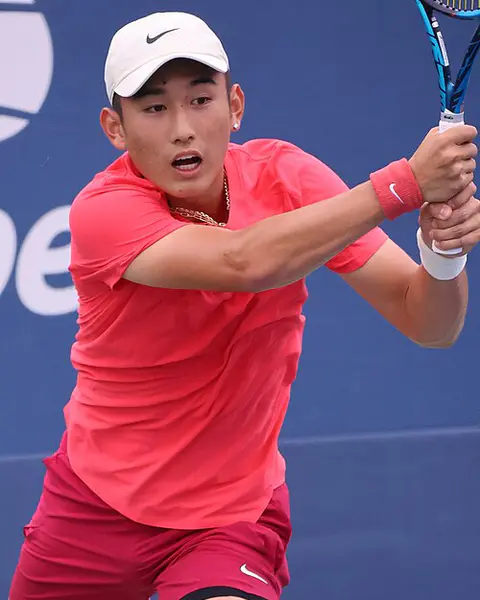 Juncheng ShangChina · 2022–2026Career-high ranking: 47
 Yi ZhouChina · 2023–2025Career-high ranking: 217
 Fajing SunChina · 2023–2025Career-high ranking: 197
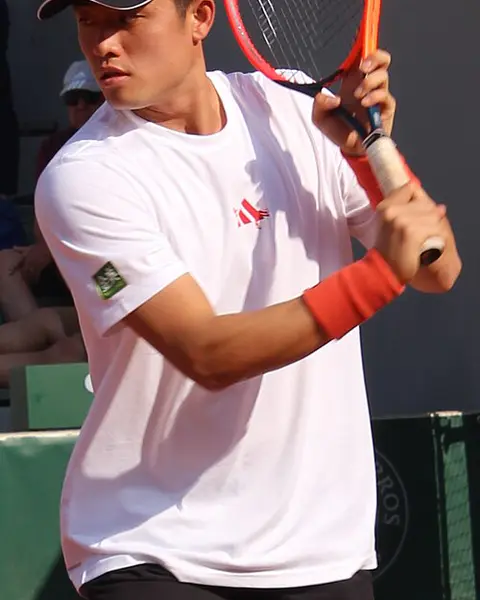 Yibing WuChina · 2017–2026Career-high ranking: 54
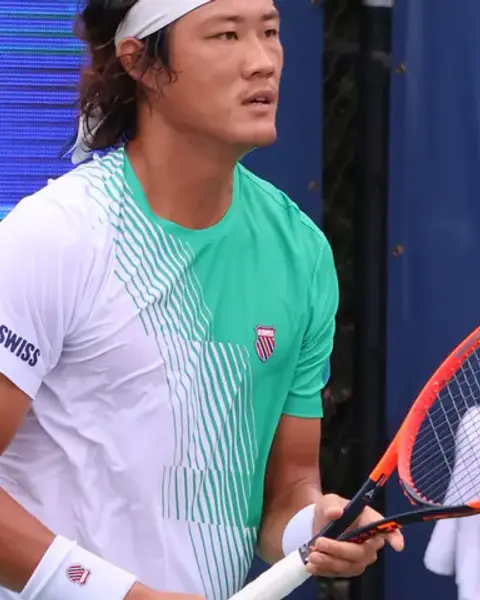 Zhizhen ZhangChina · 2015–2026Career-high ranking: 31
 Ben SheltonUnited States · 2022–2026Career-high ranking: 5
TENNIS TENSION LAB
Check your racquet’s tension today.
Get a high-precision tension reading in under 10 seconds. Tension Lab tracks changes from your first reading and helps you see when to restring.
- High-precision tension measurement. Ready in under 10 seconds.
- Track every change in feel. See the full story over time.
- Time to restring? Never leave it to guesswork.