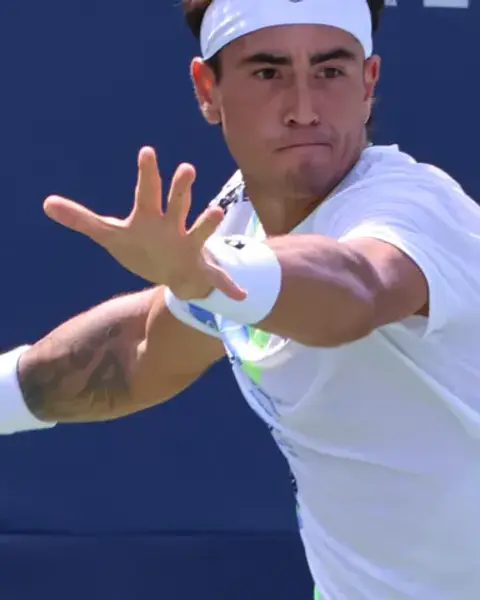
ATP · Active · Argentina
Francisco Comesaña
Career-high ranking: 54
Francisco Comesaña: Wimbledon pressure, Rio workload and the facts worth keeping
Comesaña’s 2024 Wimbledon run was not only the Rublev upset. The five-set Walton match, the Jarry match point in Rio and the Zverev comeback show how serve pressure, accumulated workload and careful sourcing change the way his progress should be read.
- Status
- Active
- Age
- Age 25
- Height
- 178 cm
- Playing hand
- Right-handed
- Tour wins
- 29 / 72
- Tour titles
- 0
- Grand Slam titles
- 0
- Career win rate
- 40.3%
The first Wimbledon match: more than a surface surprise
Comesaña made his major main-draw debut at Wimbledon in 2024 and beat sixth seed Andrey Rublev in the opening round. His profile records the result as his first tour-level win, first Grand Slam win and first victory over a top-10 player. One match therefore crossed several career thresholds at once.
The fact that it was only his second grass-court match is useful context, but it should not turn into a claim that grass was already his best surface. The better lesson is narrower and more practical: even on an unfamiliar court, the first ball after the return, short-ball decisions and enough serve pressure can make a higher-ranked opponent uncomfortable.
Walton, 7–6(8): why the final tiebreak matters more than the shorthand
In the second round, Comesaña beat Adam Walton 7–5, 1–6, 6–7(12), 6–1, 7–6(8). The Buenos Aires Herald reported that the match lasted more than four hours and that Comesaña hit 19 aces. Those 19 aces belong to the Walton match, not to the Rublev upset.
The final set is written as 7–6(8), but Wimbledon’s deciding-set match tiebreak is played to 10. The practical reading is a 10–8 finish. That detail matters because it prevents the common mistake of treating the score as a regular seven-point tiebreak and losing the pressure of the last two points.
This match also keeps the analysis from becoming a simple serve story. In a fifth set, serve output, the balance between short and long points and the final tiebreak choices all interact. A useful replay watch should separate the serve that starts the point, the first neutral ball and the decision that turns the exchange forward.
The US Open third round: a second major run on hard courts
Later in 2024, on his US Open debut, Comesaña beat Dominic Stricker and Ugo Humbert to reach another third round. Read together with Wimbledon, the result makes it harder to dismiss the summer as a one-court anomaly. Grass and hard courts ask different timing questions, but two third rounds in first appearances show a broader competitive step.
Compare more than the round reached. Watch the first groundstroke after a deep return, where he contacts short balls and when he chooses to change direction in longer rallies. Those details show how the same player adjusts to different bounce and pressure patterns.
Jarry in Rio: 3h14, a saved match point and a first ATP 500 quarterfinal
At Rio in 2025, Comesaña beat Nicolás Jarry 7–6(4), 6–7(1), 7–6(6) to reach his first ATP 500 quarterfinal. Tennis Majors gave the match duration as 3h14. Combined with the previous win over Gustavo Heide, his first two rounds had already taken 6h35.
The decisive detail came at 5–6 in the final tiebreak, when Jarry held match point and put a backhand return into the net. Comesaña survived from there. Instead of reducing the point to a mental-strength label, track the serve location, the return height and how much time the server would have had for the next ball.
The Heide score, 7–6(2), 6–7(7), 6–3, explains why this was not an isolated marathon. Two long matches in two rounds changed the context for the rest of the week. Later errors or conservative choices should be read against that workload before being described as purely technical decisions.
The Zverev comeback: keep the verified facts, discard the noisy ones
In the Rio quarterfinal, Comesaña defeated then-world No. 2 Alexander Zverev after trailing 1–4 in the deciding set. That verified comeback is enough to carry the point. The available report contains inconsistencies in the full score and in surrounding date and place wording, so this column leaves those details out.
That restraint is part of the analysis. The confirmed facts are the opponent’s ranking context, the 1–4 deciding-set deficit and the accumulated length of the earlier rounds. The unconfirmed point sequence should not be invented. A useful expert column gains authority by separating what is known from what would merely make a sharper story.
Name spelling, height and ranking scope
Born on 6 October 2000, Comesaña plays right-handed with a two-handed backhand. He is listed at 178 cm and reached a career-high ATP singles ranking of No. 54 on 18 August 2025. Search results may also show Comesana, without the ñ.
This article keeps the accented surname in English, French and Spanish, while using stable localized names elsewhere. The point is practical: a player page should not make the reader wonder whether two spellings refer to two different players.
Results by surface
Read each win rate together with its recorded match sample.
- Clay
- 42.1%38 matches
- Hard
- 37.9%29 matches
- Grass
- 40.0%5 matches
Career timeline by age
· Age 23
First recorded tour match
The first main-draw tour match covered by the current data set.· Age 24
Career-high ranking: No. 54
The highest position found in the available weekly singles rankings.· Age 25
Most recent recorded match
The latest tour match included in the current snapshot.
Reviewed sources
A result-based profile built from surface results, rankings, titles, and playing hand. Missing shot-speed, spin-rate, and point-pattern data are not invented.
Player reference page ↗Players to explore next
 Mariano NavoneArgentina · 2024–2026Career-high ranking: 29
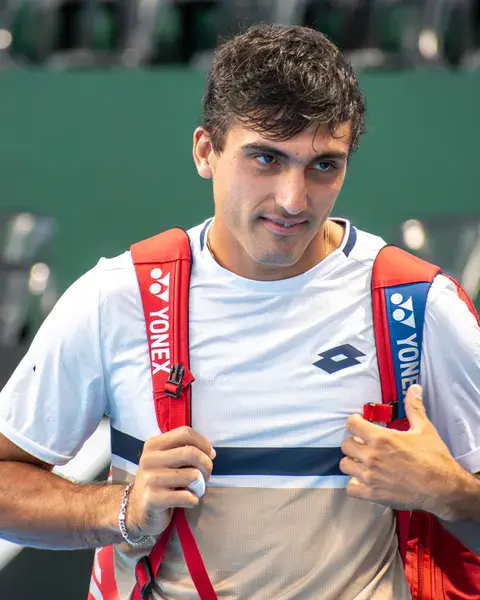 Roman Andres BurruchagaArgentina · 2024–2026Career-high ranking: 56
 Federico Agustin GomezArgentina · 2024–2026Career-high ranking: 133
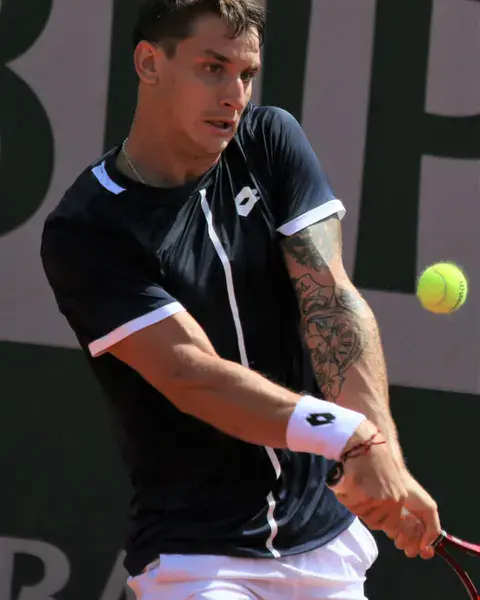 Camilo Ugo CarabelliArgentina · 2022–2026Career-high ranking: 43
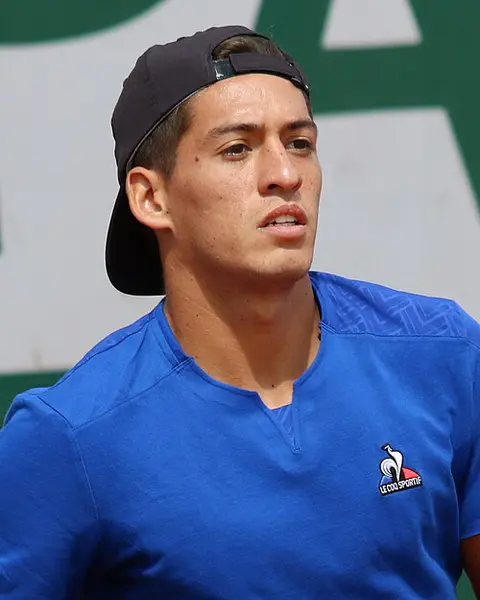 Sebastian BaezArgentina · 2021–2026Career-high ranking: 18
 Tomas Martin EtcheverryArgentina · 2021–2026Career-high ranking: 25
TENNIS TENSION LAB
Check your racquet’s tension today.
Get a high-precision tension reading in under 10 seconds. Tension Lab tracks changes from your first reading and helps you see when to restring.
- High-precision tension measurement. Ready in under 10 seconds.
- Track every change in feel. See the full story over time.
- Time to restring? Never leave it to guesswork.