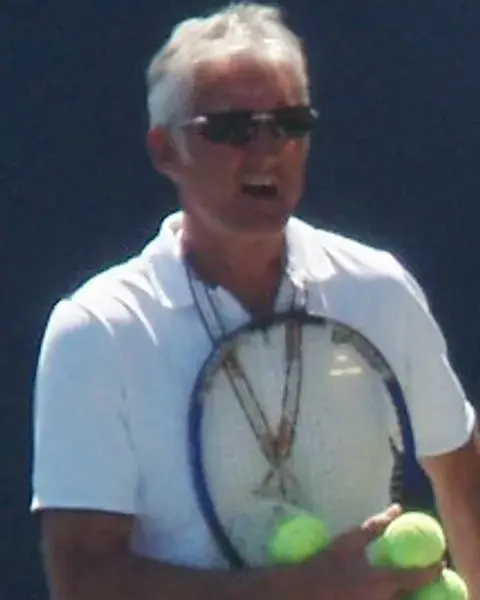
ATP · Retired · Spain
José Higueras
Career-high ranking: 6
José Higueras: reading a playing career alongside a coaching career
A Roland Garros semifinalist in 1982 and 1983 and a former world No. 6, Higueras later worked with Michael Chang, Jim Courier and other leading players. The two careers need separate measures.
- Status
- Retired
- Age
- Age 73
- Height
- 178 cm
- Playing hand
- Right-handed
- Tour wins
- 456 / 703
- Tour titles
- 17
- Grand Slam titles
- 0
- Career win rate
- 64.9%
The playing record on clay
Born on 1 March 1953, Higueras represented Spain. He is listed at 178 cm and played right-handed with a one-handed backhand. He reached the Roland Garros semifinals in 1982 and 1983 and a career-high singles ranking of No. 6 on 13 June 1983.
His equipment and competitive setting differed from today’s tour. Comparisons should account for opportunity, tour structure and record coverage. Adding modern string tensions or shot speeds to a historical profile without evidence would reduce its accuracy.
Chang and Courier: describe the contribution precisely
After retiring as a player, Higueras helped coach Michael Chang to the 1989 Roland Garros title. He also worked with Jim Courier alongside Brad Stine during a period in which Courier became world No. 1 and won multiple majors.
A title won by a coached player is separate from a coach’s own playing record. Success also involves the player and a wider team. Identifying the period and role is more precise than assigning the creation of a champion to one person.
The Federer collaboration and development role
Higueras joined Roger Federer for the clay season in 2008, with the collaboration extending into the grass and hard-court seasons. In September that year he was appointed USTA director of coaching for elite player development. Coaching an individual and overseeing a development system involve different responsibilities.
Those appointments do not establish that he introduced any particular stroke or drill. Attributing a tactical change requires contemporary interviews or training material. A verified career connection is not itself proof of a specific technical intervention.
A useful lesson: make the learning question observable
When studying clay tennis, watch how a player uses the space created by moving the opponent. A wide angle without sufficient depth can leave the hitter defending the next ball. Location and depth should be considered together.
In a lesson, bring examples of the situations in which you are late or miss repeatedly, alongside an aspirational player comparison. Observable situations make progress easier to assess with a coach. This is an editorial suggestion rather than a reproduction of Higueras’s private coaching material.
Results by surface
Read each win rate together with its recorded match sample.
- Clay
- 67.8%568 matches
- Carpet
- 48.3%58 matches
- Hard
- 54.9%51 matches
- Grass
- 50.0%8 matches
Career timeline by age
· Age 15
First recorded tour match
The first main-draw tour match covered by the current data set.· Age 23
First tour title
A verified tour-title milestone in this player’s career.· Age 30
Career-high ranking: No. 6
The highest position found in the available weekly singles rankings.· Age 32
Most recent recorded match
The latest tour match included in the current snapshot.
Reviewed sources
A result-based profile built from surface results, rankings, titles, and playing hand. Missing shot-speed, spin-rate, and point-pattern data are not invented.
Player reference page ↗Players to explore next
 Jairo VelascoSpain · 1968–1983Career-high ranking: 46
 Manuel OrantesSpain · 1968–19841 Grand Slam titles
 Angel GimenezSpain · 1975–1984Career-high ranking: 41Brian GottfriedUnited States · 1970–1984Career-high ranking: 3
 Eddie DibbsUnited States · 1970–1984Career-high ranking: 5Billy MartinUnited States · 1972–1982Career-high ranking: 32
TENNIS TENSION LAB
Check your racquet’s tension today.
Get a high-precision tension reading in under 10 seconds. Tension Lab tracks changes from your first reading and helps you see when to restring.
- High-precision tension measurement. Ready in under 10 seconds.
- Track every change in feel. See the full story over time.
- Time to restring? Never leave it to guesswork.