If thinner strings feel livelier and add spin, why doesn't everyone use them?
A thinner gauge's lively response comes with the cost of faster wear and breakage.
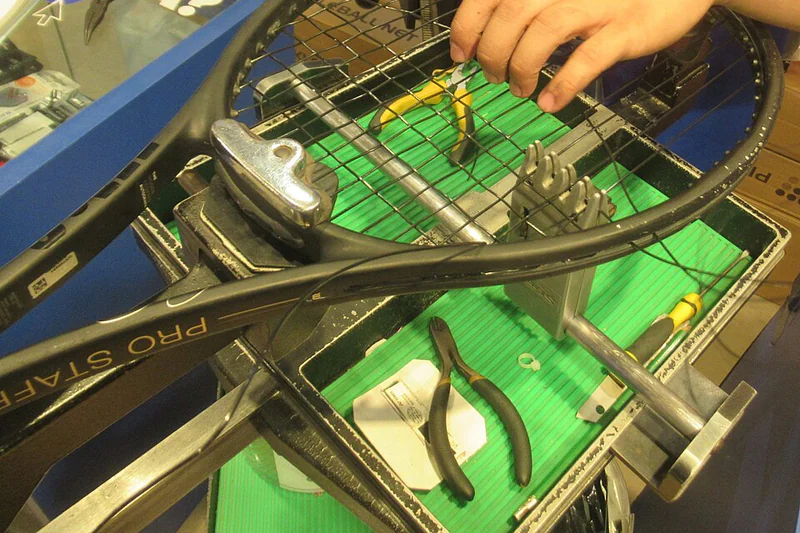
Start with this check
Gauge describes string diameter, and the ITF material identifies roughly 1–1.5 mm as a commonly used range. Within the same construction, a thinner string may generally be more flexible, but its smaller cross-section leaves less material to wear through at intersections and can reduce durability. Labels such as 17 gauge can overlap in their actual mm values across brands and systems, and evidence is insufficient to conclude that thinner string must create more spin. Check physical diameter and on-court results separately.
Try these steps in order
- Find the current string's diameter in mm on the package or in the manufacturer's specifications. If you do not know it, do not compare only the names 16 and 17; confirm the exact model and gauge with a stringer. Determine whether the last three sets broke after a few hours at center intersections or abnormally near the frame. For frame-side breaks, request a grommet, clamp, and knot inspection before choosing another gauge.
- Consider one gauge thinner in the same product family only if you rarely break the current string and want to test a crisper response. Keeping material and surface shape the same makes the diameter effect easier to compare. Prepare a fresh reference and candidate in the same racquet at the same reference tension with the same stringer, then alternate for 15 minutes each. Include topspin rallies, flat drives, and serves, and record net clearance, depth, and feel on centered contact.
- After each session, photograph notching in the center mains and crosses under the same light, and record whether strings remain displaced and the actual time to breakage. Count the loss of the initial crisp response separately from breakage time. Adopt the thinner candidate only when average trajectory or feel moves in the desired direction and its replacement cycle and cost are acceptable. If it merely breaks faster and the result does not repeat, the original diameter is the more rational choice.
Bottom line
A thinner string is not a premium grade; it exchanges wear margin for the chance to test a more flexible, lively response. It makes sense in your setup only when actual diameter, matched-condition trajectory, notching progression, and satisfactory playing time all support it.
TENNIS TENSION LAB
Check your racquet’s tension today.
Get a high-precision tension reading in under 10 seconds. Tension Lab tracks changes from your first reading and helps you see when to restring.
- High-precision tension measurement. Ready in under 10 seconds.
- Track every change in feel. See the full story over time.
- Time to restring? Never leave it to guesswork.
Reviewed sources
Technical evidence is shown separately from community topic signals.