Why do Kevlar strings require extra caution?
Extreme durability comes with a clear cost: very high stiffness and low elasticity.
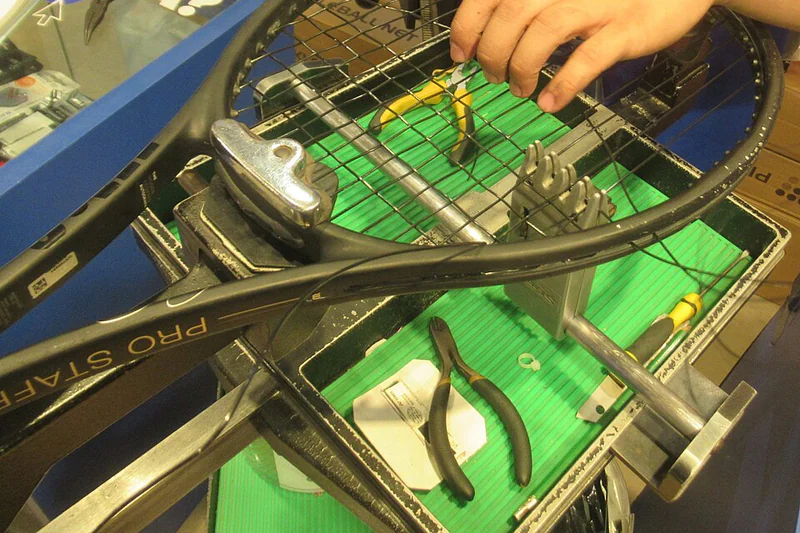
Start with this check
ITF string material places Kevlar toward the very stiff end of the commercial string spectrum and describes its use for durability in synthetic constructions. Its low elasticity and high stiffness prevent “lasts a long time” from being considered in isolation. It may be a hypothesis for a player who repeatedly breaks other strings in the center within a short time and has already ruled out gauge, grommet, and stringing problems. It is not a universal performance upgrade or a solution to arm symptoms.
Try these steps in order
- Gather the products, gauges, break locations, and cumulative hours for the last three sets. If a break occurs near the frame rather than through center notching, do not make Kevlar the candidate; inspect parts and stringing condition first. State the problem numerically, such as “Center breakage is frequent enough that the monthly stringing cost is unaffordable.” Wanting a firmer feel or an advanced-player image is not a reason to accept very high stiffness.
- First test a less-extreme alternative under the same conditions, such as the existing material one gauge thicker or a durability-oriented polyester. If it meets the target life, there is no reason to proceed to Kevlar. If a candidate remains necessary, ask an experienced stringer about the racquet's permitted range, mains and crosses, a softer cross, and a conservative starting point. Do not copy an internet number and order a full bed.
- Limit the first playtest to a short mini-rally, 10 baseline balls, and 5 serves. Immediately record impact feel, whether you had to hit harder for depth, and whether racquet-face control changed. Stop the comparison if it is uncomfortable. Decide only after tracking at least three times not just break life but normal-swing trajectory, condition after the session and the next day, and stringing cost. Return to the previous material if losses outside the target are substantial.
Bottom line
Kevlar is not a badge of a strong player. It is an extreme material to consider only when center-breakage cost remains unacceptable after other causes are excluded. Less-stiff alternatives, expert stringing, a short test, and immediate stopping criteria must all be in place.
TENNIS TENSION LAB
Check your racquet’s tension today.
Get a high-precision tension reading in under 10 seconds. Tension Lab tracks changes from your first reading and helps you see when to restring.
- High-precision tension measurement. Ready in under 10 seconds.
- Track every change in feel. See the full story over time.
- Time to restring? Never leave it to guesswork.
Reviewed sources
Technical evidence is shown separately from community topic signals.
Technical evidence
- International Tennis FederationStrings — equipment technical guide
- Tennis Warehouse UniversityString Stiffness — Dynamic and Static Measurements
- Tennis WarehouseRacquet and String Terms — Reference and Actual Tension
- Shoulder & ElbowRacquet string tension directly affects force experienced at the elbow