Check snapback in 30 seconds
If the mains stay displaced sideways, their response may have changed since the strings were new.
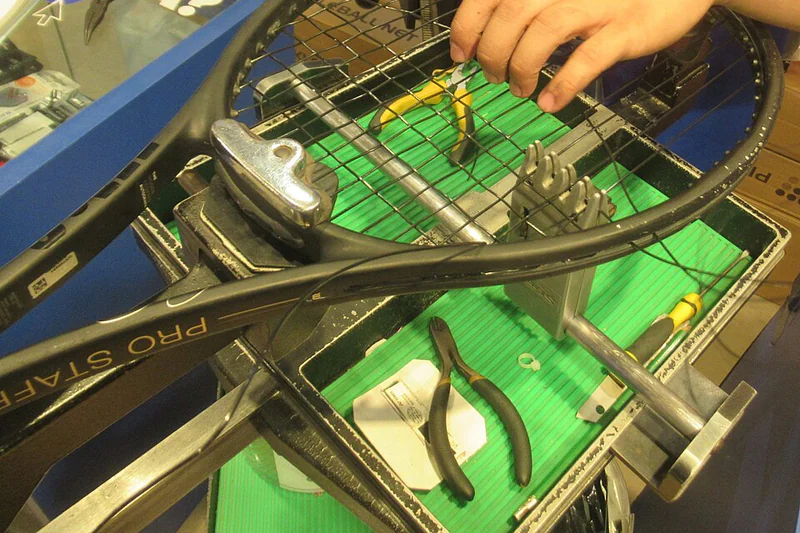
Start with this check
On a topspin impact, the mains' lateral movement and return within the stringbed can contribute to spin. As intersections notch and surface friction changes with use, a string may remain out of alignment. Finger pressure is not the same as ball impact, however, so this 30-second check is not a laboratory spin measurement. It is only a condition check asking whether movement has changed since the strings were new, and it is not enough for a restringing decision without current on-court response and cumulative playing time.
Try these steps in order
- Place the racquet on a flat, well-lit surface and use a dry cloth to remove dirt and sweat from your hands and the stringbed. A photograph of the center on the freshly strung day provides a reference for later change. With a fingertip, move one main in the center of the contact zone about 3–5 mm sideways and release it. Repeat at points above and below, observing whether it returns immediately, returns slowly, or stays displaced.
- Under oblique light, inspect four intersections and note whether notching is deeper in a main or a cross. Add the date and cumulative time to photographs of fraying, coating loss, and worn edges. On court, hit 15 crosscourt topspin balls with the same balls and record net clearance and first-bounce depth. Separate a stable trajectory despite slow string return from an unusual high launch despite a normal-looking stringbed.
- If at least two of slower snapback, deep notching, and unpredictable trajectory repeat when compared with the fresh-string record, mark the setup as a candidate for restringing. Before an important match, leave enough margin instead of assuming the remaining life will be sufficient. After restringing, repeat the check to see whether snapback and on-court response actually recover. If neither changes, inspect swing, balls, and environment one variable at a time rather than blaming string condition.
Bottom line
The 30-second snapback check is not a pass/fail stamp. Combine the fresh-string photograph, cumulative hours, intersection wear, and trajectory from the same court drill to inform a restringing decision before breakage.
TENNIS TENSION LAB
Check your racquet’s tension today.
Get a high-precision tension reading in under 10 seconds. Tension Lab tracks changes from your first reading and helps you see when to restring.
- High-precision tension measurement. Ready in under 10 seconds.
- Track every change in feel. See the full story over time.
- Time to restring? Never leave it to guesswork.
Reviewed sources
Technical evidence is shown separately from community topic signals.