Finding Your First Reference Tension
Rather than copying a professional’s number, first create a starting point you can retest with your own racquet and strings.
Start with this check
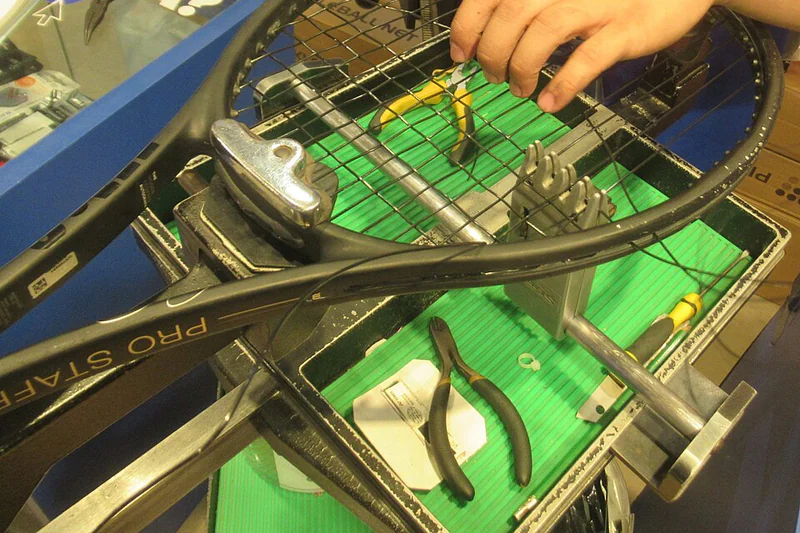
Your first reference tension is not a right answer to guess in one attempt. The reference tension entered on the stringing machine, the estimated current tension reported later by an app, and stringbed stiffness—the finished stringbed’s resistance to a defined load—are related but distinct values. Even at the same 52 lb, head size, actual pattern density, string material and diameter, machine, and stringing sequence can change the finished response. The purpose is not to copy a famous player’s number, but to establish a personal baseline that makes later changes explainable.
Try these steps in order
- Check the exact model name, generation, and recommended range on the inside of the frame and the manufacturer's product page, and if it is a used racquet, inspect for cracks and grommet damage first.
- Record the exact string product, material group, actual diameter in mm, and whether the setup is a full bed or hybrid. Do not infer material stiffness from a marketing word such as “soft.”
- Without a reliable personal history, choose a conservative starting point where the racquet’s recommended range and the string maker’s guidance overlap. The midpoint is convenient, not universally optimal.
- Ask the stringer to record the machine-set reference tension and unit for the mains and crosses. Keep that process value separate from the app’s estimated current tension.
- After stringing, choose a repeatable time and place, take three readings, and save the median as the first baseline measurement. It is a tracking value for that racquet, not a reconstruction of the original machine setting.
- Across two or three play sessions, use the same drill to evaluate depth errors, net errors, impact feel, and predictability on serve and return. At the next stringing job, adjust only one variable by a small amount.
Bottom line
A useful first reference tension is not the most impressive-looking number. It is a baseline that preserves the stringing process, measurement context, and play results so the next choice can be explained.
TENNIS TENSION LAB
Check your racquet’s tension today.
Get a high-precision tension reading in under 10 seconds. Tension Lab tracks changes from your first reading and helps you see when to restring.
- High-precision tension measurement. Ready in under 10 seconds.
- Track every change in feel. See the full story over time.
- Time to restring? Never leave it to guesswork.
Reviewed sources
Technical evidence is shown separately from community topic signals.