Should You Change Tension When You Switch to a Thinner Gauge?
There is no fixed rule to raise or lower tension by a few lb when moving from 1.25 mm to 1.20 mm. To isolate the gauge effect, compare within the same product construction and coating whenever possible.
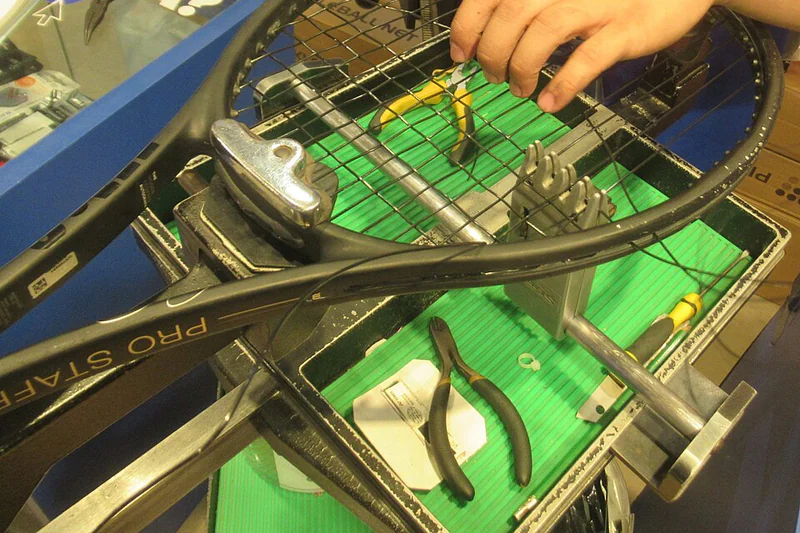
Start with this check
Gauge describes string diameter, but labels such as 16 or 16L may map to different mm values across brands and products. Within one product, a thinner option generally bends more readily and wears faster, but material, shape, and construction differences between products can outweigh that tendency. The same machine-set reference tension also does not guarantee the same finished stringbed stiffness, launch angle, or estimated-current-tension trend. Changing diameter and reference tension substantially at the same time makes the cause of any response change hard to isolate.
Try these steps in order
- Record the brand, exact product name, color, and mm diameter indicated on the packaging of both the old and new strings, along with photos. If there is only a numeric gauge and no mm, check the manufacturer's official specifications.
- If possible, use the same product and color in a different diameter, choosing fresh sets or separate reels with comparable storage histories, and maintain the machine-set reference tension, frame, stringer, and machine for the first comparison. If there are official ranges or separate manufacturer guidelines, prioritize them.
- Match the elapsed time from stringing completion to the first measurement for both setups. Store machine-set reference tension as a process record, and store estimated current tension and stringbed stiffness as separate result fields.
- Using the same balls, repeat centered-contact rallies, higher-trajectory balls, and serves. Record launch angle, long errors, perceived dwell, and sound instead of compressing every difference into “soft.”
- For each session, record cumulative playing time, movement of the mains and crosses, the location and depth of intersection notching, and actual time to breakage. Evaluate any benefit of the thinner string together with its replacement cycle.
- When the same problem recurs in two or three similar sessions, change the machine-set reference tension by a small margin only for the next stringing job. At that time, fix the diameter and product to observe the results of string tension adjustment separately.
Bottom line
Interpret a gauge change only after confirming the diameter in mm and holding other conditions steady. Observe the first setup without a simultaneous tension change, then use later setups for small, evidence-based adjustments.
TENNIS TENSION LAB
Check your racquet’s tension today.
Get a high-precision tension reading in under 10 seconds. Tension Lab tracks changes from your first reading and helps you see when to restring.
- High-precision tension measurement. Ready in under 10 seconds.
- Track every change in feel. See the full story over time.
- Time to restring? Never leave it to guesswork.
Reviewed sources
Technical evidence is shown separately from community topic signals.