Why Use Different Tensions for Hybrid Mains and Crosses?
A mains/crosses tension difference in a hybrid is not governed by a formula such as “always string the crosses 2 lb lower.” It is a setup choice for coordinating two materials and their intended roles.
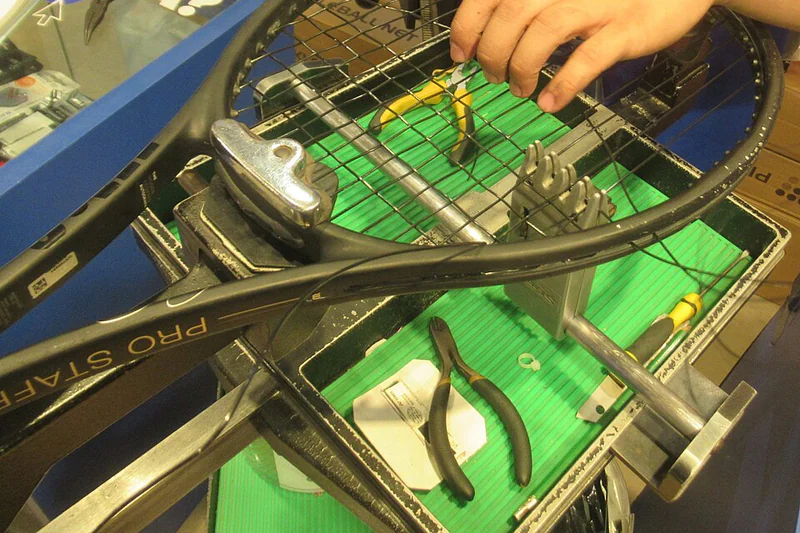
Start with this check
A hybrid uses mains and crosses that differ in material, dynamic stiffness, diameter, surface friction, and tension maintenance, so equal reference settings do not make their roles identical. The mains often dominate lateral movement and much of the stringbed response, while the crosses influence that movement, overall stiffness, and wear. There is no universal rule to raise or lower one direction by a fixed number of lb merely because polyester is installed there. Check the racquet maker’s model-specific stringing instructions, any string-combination guidance, frame geometry, and the player’s goal.
Try these steps in order
- Determine two priorities among spin, comfort, breakage durability, and feel, and decide which material will fulfill those roles. Do not decide the direction simply because “pros use it.”
- Verify the exact product, material, gauge, and manufacturer guidance for both strings. With the stringer, choose starting values that follow the racquet model’s pattern, knot locations, and recommended tension range.
- Record the mains and crosses reference tensions separately, including units, pre-stretch, stringing machine, and knot method. Do not hide two settings behind one average.
- At a defined time after stringing, record estimated current tension, while noting that an app’s average estimate does not report the actual tension of each direction separately. Keep any stringbed-stiffness result in its own field as a different measurement type.
- In the same drill over time, record how readily the mains return to position, intersection notching, which direction breaks, and changes in launch angle, depth, and impact feel.
- In the next stringing job, change only one of the following: material direction, one-sided reference tension, or gauge, and compare with the existing racquet to verify that the intended purpose of the change has been achieved.
Bottom line
A hybrid’s mains/crosses tension difference is not a fixed recipe. Treat it as a small, one-variable experiment guided by material roles, model-specific instructions, and wear history.
TENNIS TENSION LAB
Check your racquet’s tension today.
Get a high-precision tension reading in under 10 seconds. Tension Lab tracks changes from your first reading and helps you see when to restring.
- High-precision tension measurement. Ready in under 10 seconds.
- Track every change in feel. See the full story over time.
- Time to restring? Never leave it to guesswork.
Reviewed sources
Technical evidence is shown separately from community topic signals.