Does a Loose-Feeling Outer String Mean Low Tension Across the Whole Stringbed?
One outer string that moves easily by hand or produces a lower pitch does not prove that the whole stringbed was strung loose. Its free length, support, and knot location differ from those of a center string.
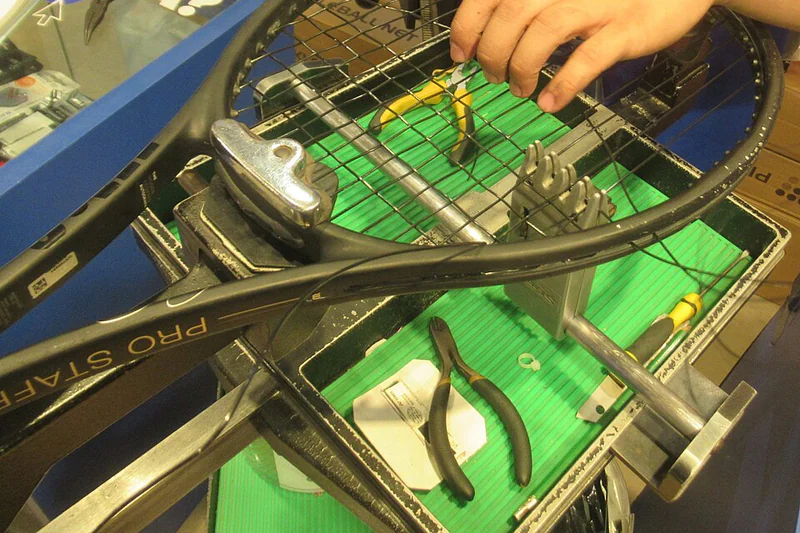
Start with this check
Machine-set reference tension is the force applied while each string is pulled; it does not mean every location must produce the same pitch or finger resistance after stringing. Outer and center strings differ in free length, support from neighboring strings, and grommet friction, and knots can create local differences. An app’s estimated current tension and a stringbed-stiffness measurement are better suited to repeatable central measurements; neither determines the exact tension of one outer string. Loose knots, damaged grommets, and severe clamp marks still require separate inspection.
Try these steps in order
- Immediately after stringing, photograph the full front and back of the racquet and every knot in bright light. Mark knot locations, changes in tail length, and any outer grommet hole that looks abnormal.
- First look for visible problems: frame cracks, split or missing grommets, loose knots, deep crushing, or white stress marks. If you cannot tell whether a condition is normal, leave it untouched and show it to the stringer.
- For a hand comparison, touch matching positions on the left and right very lightly and observe movement and sound. Do not compare the pitch of a shorter outer string directly with that of a longer center string.
- For overall condition tracking, fix the app input and position, take three measurements from the center, and compare them to the reference value when fresh. Do not treat machine-set reference tension, estimated current tension, or separate stringbed stiffness as the same number.
- During play, record any repeated unexpected launch, sound, or movement at a particular location, together with the actual contact point. One off-center contact is not evidence of a stringing defect.
- If a visible problem or irregular response recurs, send the stringer photos, the worksheet, and the repeated readings so the pattern, knots, and grommets can be inspected. Keep the result for comparison after the next stringing job.
Bottom line
The feel of one local string and the condition of the whole stringbed are different diagnostic targets. Symmetric inspection, repeated central measurements, and post-stringing photos help separate normal positional differences from problems that need attention.
TENNIS TENSION LAB
Check your racquet’s tension today.
Get a high-precision tension reading in under 10 seconds. Tension Lab tracks changes from your first reading and helps you see when to restring.
- High-precision tension measurement. Ready in under 10 seconds.
- Track every change in feel. See the full story over time.
- Time to restring? Never leave it to guesswork.
Reviewed sources
Technical evidence is shown separately from community topic signals.