Why the Same Tension Can Feel Different Between Stringing Shops
If two shops both strung a racquet at 52 lb but the result feels different, the machine name alone is not the explanation. Pulling system, calibration, clamps, pull duration, stringing sequence, and knots all affect reproducibility.
Start with this check
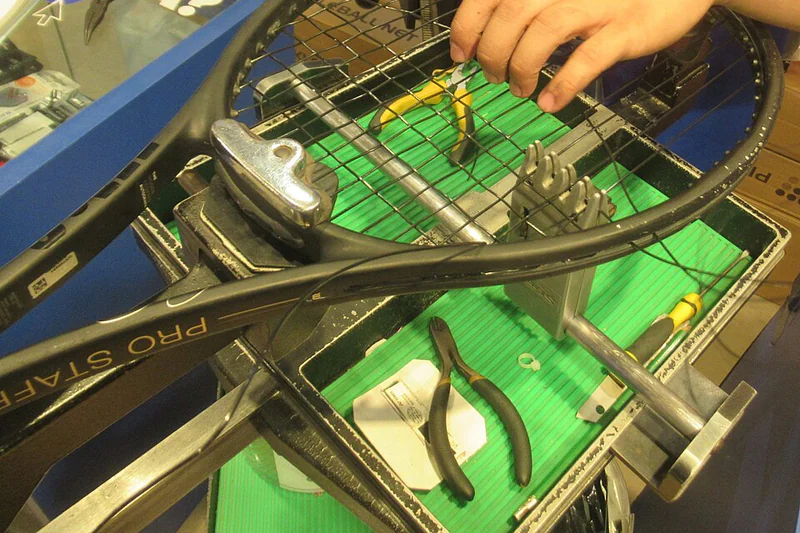
Machine principles differ: a constant-pull machine continues trying to maintain the set load, while a lockout machine stops pulling once the set point is reached. Even within one type, calibration, pull speed, clamp slippage or pressure, string friction, and the stringer’s procedure can change the result. Machine-set reference tension is the requested input; an app’s estimated current tension is a vibration-based estimate of the completed stringbed; stringbed stiffness is a separate metric. A difference among the three cannot by itself identify a stringing error or quantify tension loss.
Try these steps in order
- Record the exact model, string product, color, and mm diameter for each racquet, mains and crosses settings, prestretch, and stringing date. When making comparisons, use the same frame and the same reel whenever possible.
- Politely confirm with the shop or stringer the machine manufacturer/model, methods such as constant pull/lockout, and whether recent calibration checks have been performed. Do not estimate unknown information; leave it as unconfirmed.
- Put any requested knot, pull speed, or pre-stretch on the order form and communicate it again at the next stringing job. Read back the individual process details instead of saying only “same as last time.”
- Record completion time and, before play, take three readings after the same elapsed time in the same room with the same measurement device, inputs, support, and location. Save the median app value as that racquet’s baseline; do not judge quality by whether it equals the machine setting.
- Collect at least two stringing jobs under the same conditions at one shop before judging its internal repeatability. How consistently each shop reproduces its own process is more informative than one between-shop difference.
- If the difference repeats on court, record launch angle and errors in centered-contact rallies and serves, then share the record with the stringer. If needed, change one process variable at the next job and compare before and after.
Bottom line
Reducing shop-to-shop variation takes more than repeating the setting number. Record the machine, string, procedure, and measurement timing together, and keep process values separate from result metrics when comparing reproducibility.
TENNIS TENSION LAB
Check your racquet’s tension today.
Get a high-precision tension reading in under 10 seconds. Tension Lab tracks changes from your first reading and helps you see when to restring.
- High-precision tension measurement. Ready in under 10 seconds.
- Track every change in feel. See the full story over time.
- Time to restring? Never leave it to guesswork.
Reviewed sources
Technical evidence is shown separately from community topic signals.