Should Mains and Crosses Use Different Tensions in a Full Bed?
There is no universal rule that the cross must always be lowered or raised by 2 lb when making a full bed with the same string. Identical mains and crosses settings can be an easy starting point, but if there are stringing instructions from the racquet manufacturer, those should come first.
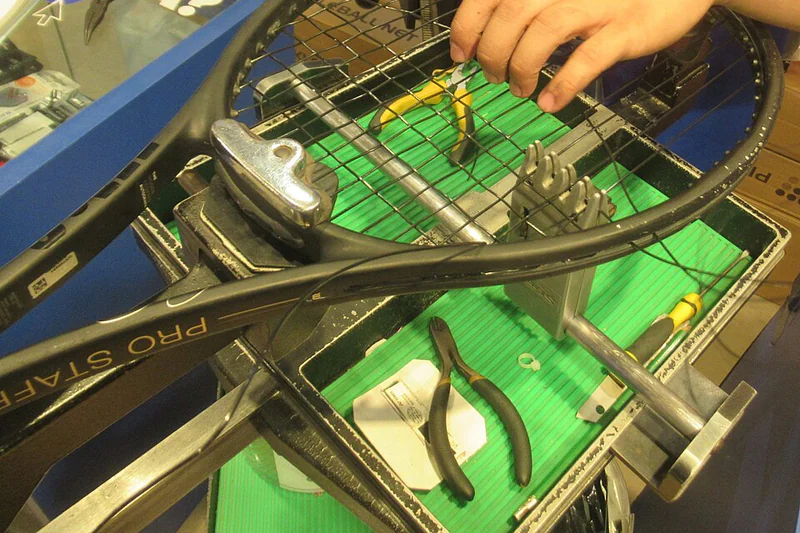
Start with this check
Mains and crosses differ in length, count, intersection friction, and frame orientation, so the finished state of every string will not be identical even at equal machine settings. That does not create a fixed correction that works for every head, pattern, or material. Reference tension is a process value for each direction, while an app’s estimated current tension and stringbed stiffness mainly reflect the combined stringbed. An unexplained differential therefore makes the cause harder to interpret, and a purposeful differential still needs to be evaluated through the whole stringbed.
Try these steps in order
- Verify the exact racquet model and generation, official string pattern, recommended tension range, and any model-specific instructions for mains, crosses, or knots. Do not substitute a pattern from a similar model.
- Record the exact product, color, and actual diameter of the full bed string, as well as the previous directional settings. Verify that it is the same product, not just the same material group.
- Unless the manufacturer’s instructions or a qualified stringer’s frame-safety judgment gives a reason to differ, consider equal mains and crosses settings as a reproducible first baseline. If a proven differential already exists, preserve its purpose and result.
- Record mains and crosses separately on the worksheet with lb or kgf units, plus the machine, stringer, and pre-stretch. Do not collapse them into one number or retain only an average.
- At the same elapsed time after stringing, record estimated current tension or stringbed stiffness, then use the same drill to track launch angle, net and long errors, string movement, and impact feel. Do not back-calculate separate actual tensions for mains and crosses from the combined measurement.
- To change launch angle or feel, define one target first and test a small differential only at the next stringing job. Keep another racquet at equal settings as the comparison and look for repeatability across two or three sessions.
Bottom line
Set full-bed mains and crosses from model-specific instructions and an explainable goal, not a universal formula. Start with a clear baseline, then change one variable to identify the actual tendency of a small tension differential.
TENNIS TENSION LAB
Check your racquet’s tension today.
Get a high-precision tension reading in under 10 seconds. Tension Lab tracks changes from your first reading and helps you see when to restring.
- High-precision tension measurement. Ready in under 10 seconds.
- Track every change in feel. See the full story over time.
- Time to restring? Never leave it to guesswork.
Reviewed sources
Technical evidence is shown separately from community topic signals.