How to Match Two Identical Racquets for Competition
Two racquets of the same model are not guaranteed to feel identical in a match simply because both were strung at 52 lb. Manufacturing variation, weight and balance, grips and dampeners, and stringing timing all affect the comparison.
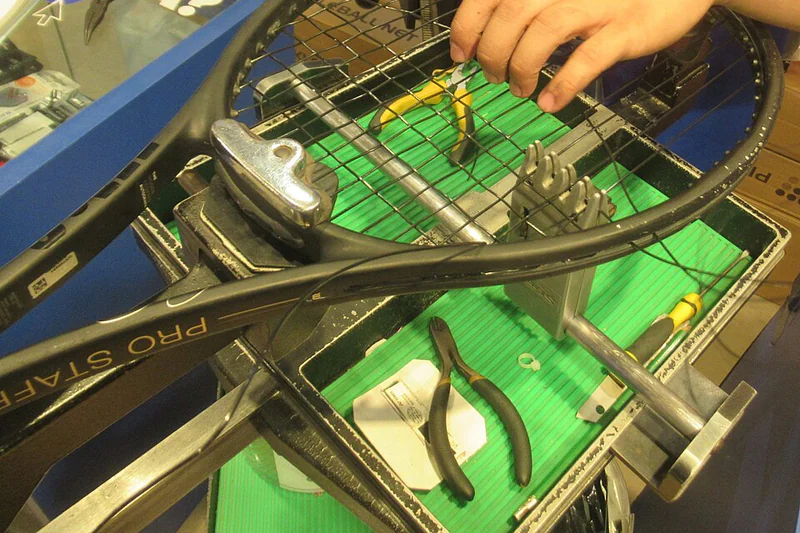
Start with this check
Machine-set reference tension can align the pulling process, but it does not automatically match two frames’ mass distribution or finished stringbed stiffness. Two examples of the same model can differ in actual weight and balance, and if only one has aged strings, its estimated current tension and friction state will differ too. App estimates are useful for tracking each racquet’s trend, but they do not fully explain frame-mass differences or directly measure stiffness. Control racquet condition and attachments first, then align the stringing process.
Try these steps in order
- Label two racquets A and B and record the exact model/generation, head size, pattern, and visible frame/grommet condition. Racquets with cracks or deformation are excluded from the matching process and inspected by a professional.
- Bring both racquets to the same string setup and strung condition and use matching grip, overgrip, and dampener setups, then measure total weight and balance. Record the tools, method, and attachment weights so figures from different conditions are not mixed.
- When possible, use the same string and actual diameter from one reel, the same stringer, machine, and process, identical mains/crosses settings, and closely spaced stringing times. Put pre-stretch and knot requests on the order form.
- Record each stringing completion time and take three estimated-current-tension or stringbed-stiffness readings per racquet after the same elapsed time. Keep settings and measurements separate, and judge repeatability rather than one absolute A-versus-B difference.
- With the same balls, test serves, blocked returns, centered-contact rallies, and changes of direction in an A-B-B-A order. On scorecards that hide racquet identity, record swing timing, centered-contact rate, depth and directional errors, and impact feel.
- If a difference recurs, rule out string freshness and measurement variation first. Handle mass customization and any later tension adjustment as separate stages, beginning with small, reversible changes verified by a qualified specialist.
Bottom line
Two match racquets become more alike through matching condition, attachments, stringing process, and elapsed-time baselines—not through identical stickers. An A/B record lets you reduce frame and string differences in sequence.
TENNIS TENSION LAB
Check your racquet’s tension today.
Get a high-precision tension reading in under 10 seconds. Tension Lab tracks changes from your first reading and helps you see when to restring.
- High-precision tension measurement. Ready in under 10 seconds.
- Track every change in feel. See the full story over time.
- Time to restring? Never leave it to guesswork.
Reviewed sources
Technical evidence is shown separately from community topic signals.