Why Does the App Reading Differ from the Requested 52 lb?
A 52 lb request at the shop and a 47 lb app reading do not automatically prove a 5 lb stringing error. The values can represent different things at different times and under different measurement methods, so label them correctly first.
Start with this check
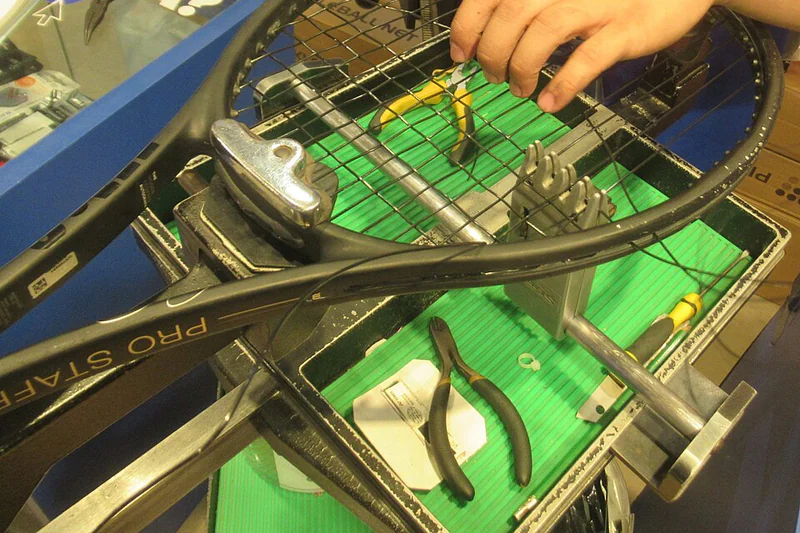
Setting tension, or reference tension, is the force specified while a stringing machine pulls each string. Because of mounting friction, clamps, knots, frame deformation, and immediate relaxation, it is not identical to the finished state of every string. An app generally uses vibration frequency plus entered head, pattern, and diameter information to report an estimated current tension; it does not reconstruct the original machine setting. Stringbed stiffness is another result describing how the finished stringbed resists a defined load. Even when units look similar, the three values are not interchangeable.
Try these steps in order
- From the receipt or worksheet, record the racquet, string product and diameter, mains/crosses reference-tension settings, and lb or kgf units. Preserve both the requested and actual stringing values if they were recorded separately.
- Record stringing completion time, stringer and machine, pre-stretch, and first-play time. Without this process context, do not back-calculate an old machine setting from an app value.
- Enter the exact head size, pattern, string material, and diameter in the app. In a quiet place, excite the same location three times with the same tool, keeping racquet support and ambient temperature as consistent as practical.
- Save the median repeated value as the post-stringing baseline estimate. If a different device reports stringbed stiffness, store its unit and value in a separate column; do not add it to or convert it directly from the app number.
- Continue the trend with playing time and date using the same procedure. Compare change from the initial baseline with launch angle, sound, and string movement, first checking whether a small difference lies inside normal measurement variation.
- If a large difference recurs with abnormal on-court response or visible damage, show the process record and three readings to the stringer for inspection. Check inputs, units, and racquet condition before requesting a restring from one number alone.
Bottom line
Machine-set reference tension is a process record, estimated current tension is a condition tracker, and stringbed stiffness is an indicator of the finished stringbed's response. Separating these three names and units allows you to create useful trends without mistaking numerical differences for errors.
TENNIS TENSION LAB
Check your racquet’s tension today.
Get a high-precision tension reading in under 10 seconds. Tension Lab tracks changes from your first reading and helps you see when to restring.
- High-precision tension measurement. Ready in under 10 seconds.
- Track every change in feel. See the full story over time.
- Time to restring? Never leave it to guesswork.
Reviewed sources
Technical evidence is shown separately from community topic signals.