
ATP · Active · France
Gaël Monfils
Career-high ranking: 6
Gaël Monfils: the recovery shot, the next attack and a serve that matters
At 193 cm, Gaël Monfils offers more than spectacular defence. His 2023 Paris comeback and 2025 win over Taylor Fritz show how recovery, attacking choices and service holds work together.
- Status
- Active
- Age
- Age 40
- Height
- 193 cm
- Playing hand
- Right-handed
- Tour wins
- 588 / 953
- Tour titles
- 13
- Grand Slam titles
- 0
- Career win rate
- 61.7%
A long career, with a precise place for the Auckland record
Monfils is listed at 193 cm and plays right-handed with a two-handed backhand. He won three boys’ singles majors in 2004, then reached senior major semifinals at Roland Garros in 2008 and the US Open in 2016. His career-high ATP singles ranking of No. 6 dates to 7 November 2016. These milestones show longevity across different stages; none is a measure of his current weekly ranking.
In the 2025 Auckland final he beat Zizou Bergs 6–3, 6–4 for his 13th tour title, at 38 years and 132 days. The oldest-champion record applies to the ATP Tour era beginning in 1990. Earlier tour-level winners were older, so “oldest in tennis history” would be inaccurate. The useful competitive detail is that a player associated with remarkable retrieving was still winning through a combination of defence and attack.
Paris 2023: the comeback did not end when he reached 4–4
Against Sebastián Báez in the first round of Roland Garros 2023, Monfils won 3–6, 6–3, 7–5, 1–6, 7–5 after trailing 0–4 with two breaks against him in the fifth set. He recovered to 4–4, lost serve again, then stopped Báez serving out the match at 5–4. A hold and another break completed the recovery. The crucial sequence includes a setback after the comeback had seemingly restored parity.
The tournament’s report describes a deeper return position and higher, looping groundstrokes during the second set, followed by more aggressive play to close it out. In the third, Monfils saved three set points from 0–40 at 4–5, then broke with a backhand winner down the line. Those are distinct changes of point situation: creating time from farther back, then changing direction to attack when the opening appears.
The fifth-set figures add a check against the familiar image of a pure retriever: Monfils struck 13 winners, while Báez won only 43% of points behind his first serve in that set. This does not mean every defensive ball forced an error, or that the return position alone caused the result. It does show why a useful review should follow the attacking shot after the recovery, rather than stop at the spectacular save.
Fritz in 2025: service protection changes the defensive workload
Monfils defeated fourth seed Taylor Fritz 3–6, 7–5, 7–6(1), 6–4 in the third round of the 2025 Australian Open. ESPN’s report records 24 aces, 58 winners against 34 unforced errors, and only one service game lost. The final point was an ace. Calling this simply a victory of endurance leaves out how effectively he protected his own serve.
The net figures were 11 points won in 15 approaches for Monfils and 16 in 30 for Fritz. Keep the attempts alongside the successes: Fritz came forward twice as often. Those small match samples cannot prove who was the better volleyer, and the quality of the approach matters before the volley is struck. They do provide a concrete question for a replay: did the approach leave the passer stretched, or able to hit from balance?
Taken with the Paris match, this suggests two separate things to watch. On return, follow how a defensive reply changes the next ball. On serve, follow how often the point reaches that demanding defensive situation at all. A strong first delivery can shorten one point while a high, deep recovery shot lengthens another; both can serve the same purpose of improving the next decision.
Surviving a ball and changing the point are different
Putting one more ball in play is not the same as making the opponent’s next attack difficult. Watch where a defensive shot lands and how far Monfils recovers while it travels. Height can buy time, but a short landing point may give the opponent another comfortable attack.
A compilation of slides and full-stretch gets often ends before the decisive information. Follow the next two shots and classify the point as defensive, neutral or attacking. That sequence reveals whether the retrieval merely prolonged the point or changed its balance.
Practice defence as a two-shot sequence
Have a partner feed wide. Send a high, deep crosscourt reply, recover and handle the next ball from balance. Record late preparation even when the first defensive shot lands. There is no need to imitate extreme slides or dives.
Score the sequence as survival, recovery to neutral or transition to attack. Begin by increasing the proportion that reaches neutral. Regaining choices after a difficult ball is more repeatable than attempting a winner every time a point turns against you.
Results by surface
Read each win rate together with its recorded match sample.
- Hard
- 64.3%614 matches
- Clay
- 57.1%245 matches
- Grass
- 56.0%84 matches
- Carpet
- 60.0%10 matches
Career timeline by age
· Age 18
First recorded tour match
The first main-draw tour match covered by the current data set.· Age 18
First tour title
A verified tour-title milestone in this player’s career.· Age 30
Career-high ranking: No. 6
The highest position found in the available weekly singles rankings.· Age 39
Most recent recorded match
The latest tour match included in the current snapshot.
Reviewed sources
A result-based profile built from surface results, rankings, titles, and playing hand. Missing shot-speed, spin-rate, and point-pattern data are not invented.
Player reference page ↗Players to explore next
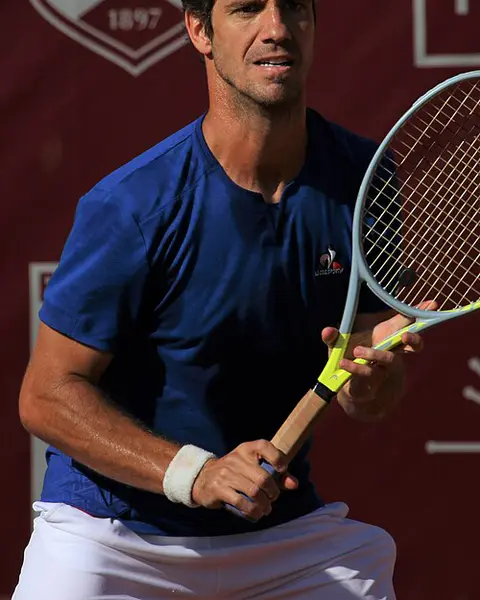 Richard GasquetFrance · 2002–2025Career-high ranking: 7
 Adrian MannarinoFrance · 2008–2026Career-high ranking: 17
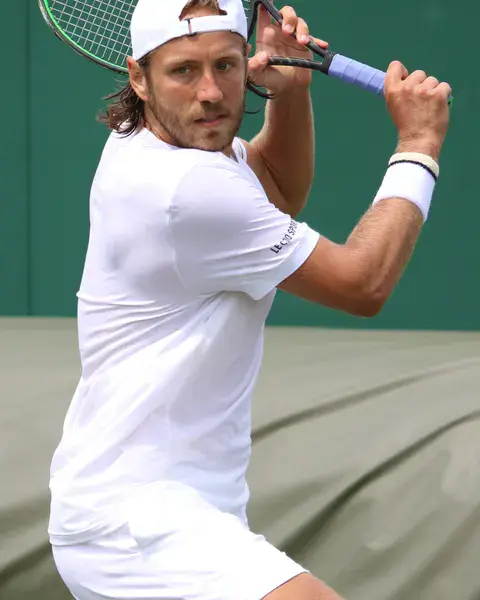 Lucas PouilleFrance · 2013–2025Career-high ranking: 10
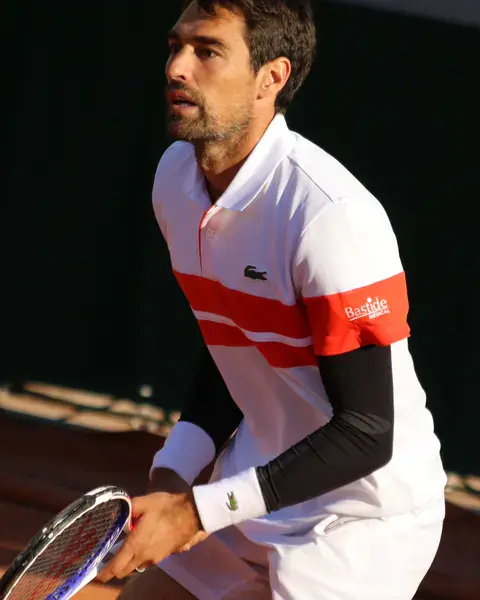 Jeremy ChardyFrance · 2006–2023Career-high ranking: 25
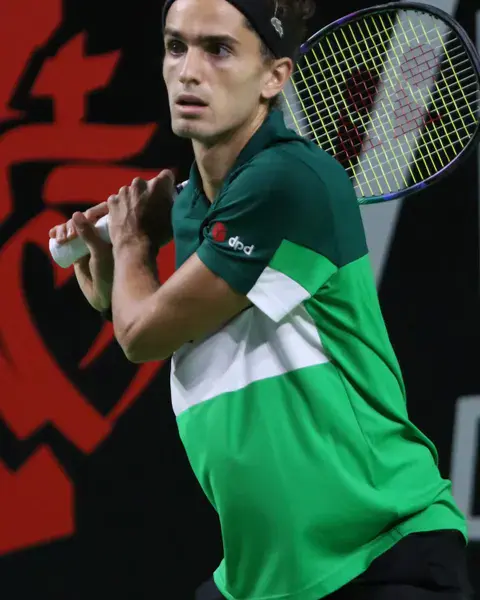 Pierre Hugues HerbertFrance · 2013–2026Career-high ranking: 36
 Quentin HalysFrance · 2015–2026Career-high ranking: 46
TENNIS TENSION LAB
Check your racquet’s tension today.
Get a high-precision tension reading in under 10 seconds. Tension Lab tracks changes from your first reading and helps you see when to restring.
- High-precision tension measurement. Ready in under 10 seconds.
- Track every change in feel. See the full story over time.
- Time to restring? Never leave it to guesswork.