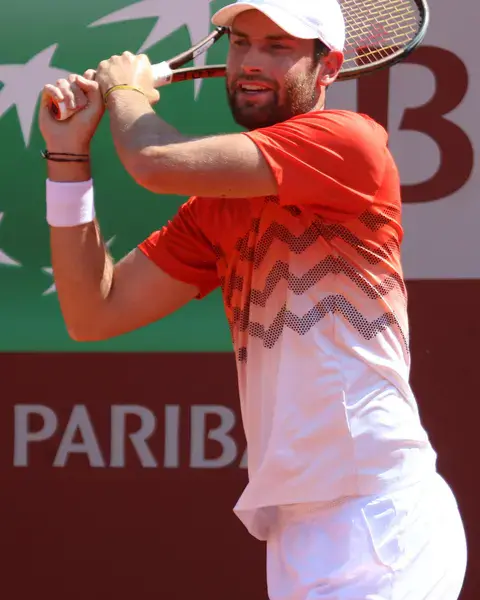
ATP · Active · France
Quentin Halys
ATP#52Ranking as of 2026-08-24
Career-high ranking: 46
Quentin Halys: big serves, tight scores and the work between tournaments
Quentin Halys is 191 cm tall. A three-tiebreak win in Miami and his explanation of Roland-Garros preparation show why an ace count alone cannot describe his tennis.
- Status
- Active
- Age
- Age 29
- Height
- 191 cm
- Playing hand
- Right-handed
- Tour wins
- 57 / 153
- Tour titles
- 1
- Grand Slam titles
- 0
- Career win rate
- 37.3%
From junior success to a first tour final
Quentin Halys, born on 26 October 1996, won the 2014 Roland-Garros boys’ doubles title with Benjamin Bonzi and reached the US Open boys’ singles final that year. His first senior major appearance followed at Roland-Garros in 2015. His first ATP singles final came much later, at Gstaad in 2024: a useful reminder of the distance between junior achievement and sustained tour results.
In 2024 he fell to No. 223, then qualified for Wimbledon and reached the third round. He also came through qualifying to make the Gstaad final. The public profile records Kitzbühel in 2026 as his first ATP singles title. Keeping qualifying, main-draw wins, finals and titles distinct makes that recovery easier to assess.
Miami 2023: 21 aces, but no easy route through
Tennis Australia’s report records Halys beating Alex de Minaur 6–7(5), 7–6(3), 7–6(8) in the second round of Miami in 2023. The match lasted 3 hours and 18 minutes. Halys saved 2 match points and converted his own second opportunity. The 21 aces are substantial, yet all 3 sets reached a tiebreak: a powerful serve did not remove the need to handle a very close finish.
The report lists 57 winners including those 21 aces. Adding the two figures would count the aces twice; subtraction leaves 36 other winners. Nor is 21 an ace percentage: that would require the number of service points played. The final 7–6(8) means the deciding tiebreak ended 10–8, with the loser’s 8 points shown in parentheses. These details help a reader interpret the match without inventing missing statistics.
Why he chose a Challenger before Roland-Garros
In the official Roland-Garros preview published on 29 May 2026, Halys explained a deliberate change of schedule. After moving from Miami hard courts to clay with little adjustment time, he skipped Rome following Madrid and played the Bordeaux Challenger, reaching the semifinals. His stated aim was to arrive in Paris with matches and confidence, rather than treat the home major as an overwhelming event.
He also discussed managing his match better than in the 2025 third-round loss to Holger Rune, which had gone to a fifth set. The article was written before his 2026 meeting with Alexander Zverev, so these comments describe preparation and intention, not proof of a successful result. Choosing a lower-tier event can be purposeful; its value depends on the matches and conditions it provides, not only the category on the entry list.
Why grass and clay results deserve separate attention
Halys reached the third round of Wimbledon in both 2023 and 2024, and the Gstaad final on clay in 2024. Those results caution against reducing a player to one surface label. An aggregate clay record can conceal differences in tournament conditions and the opponents faced.
On video, separate serves that end the point from serves that draw a short return for the next shot. In return games, watch his position against second serves and what happens after a return lands short. This gives you more to work with than an ace count alone. The questions are an analysis framework, not an unverified statistical description of his usual patterns.
What a 191 cm frame does—and does not—explain
His published height is 191 cm; he plays right-handed with a two-handed backhand. Reach can help cover the court, while balls directed close to the body still require space for contact. For a recreational player, preparation and spacing are more transferable lessons than the appearance of a large swing.
A racquet’s appearance on television does not establish the weight, balance or string tension of the professional’s actual setup. An endorsed retail model and a customised frame are different claims. Without a reliable stringing record, an exact tension would be speculation; compare setups within your own racquet’s published range instead.
Practise a close finish, then record what actually won the point
Start a practice tiebreak at 5–5 and play to 7, with a 2-point margin required. Agree on the serving order before starting. Choose a familiar serve target and record whether each point ended with an ace, another unreturned serve, a winner after the return or an error. Keep the categories separate instead of crediting every service point to raw power.
Repeat from the same score against the same partner. Compare decisions and execution on second serves and on the first playable return; winning one short sequence is too small a sample to prove that a tactic is better. This is a reader’s pressure drill prompted by the Miami match, not a documented Halys session or evidence about his usual serve direction.
Results by surface
Read each win rate together with its recorded match sample.
- Hard
- 34.3%102 matches
- Clay
- 41.2%34 matches
- Grass
- 47.1%17 matches
Career timeline by age
· Age 18
First recorded tour match
The first main-draw tour match covered by the current data set.· Age 28
Career-high ranking: No. 46
The highest position found in the available weekly singles rankings.· Age 29
Most recent recorded match
The latest tour match included in the current snapshot.
Reviewed sources
A result-based profile built from surface results, rankings, titles, and playing hand. Missing shot-speed, spin-rate, and point-pattern data are not invented.
Player reference page ↗Players to explore next
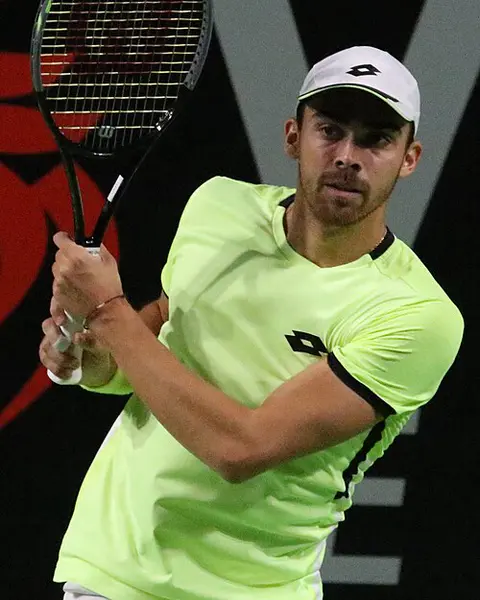 Benjamin BonziFrance · 2017–2026Career-high ranking: 42
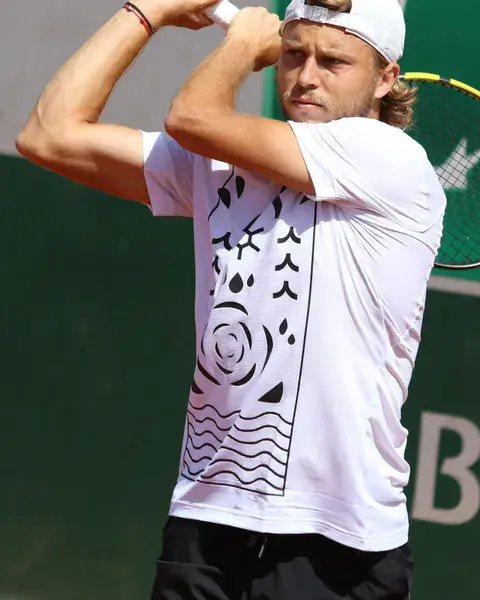 Alexandre MullerFrance · 2017–2026Career-high ranking: 38
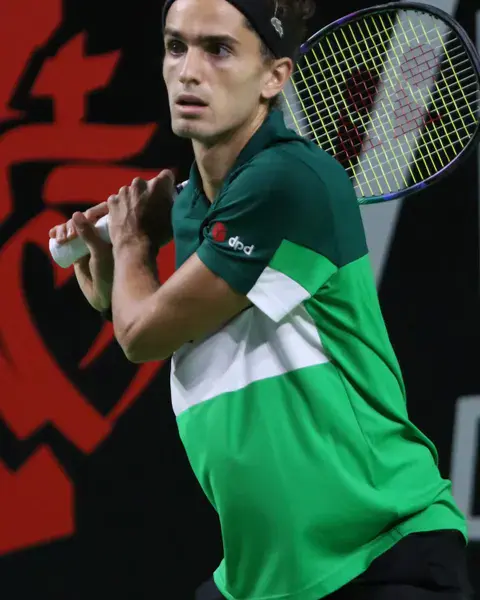 Pierre Hugues HerbertFrance · 2013–2026Career-high ranking: 36
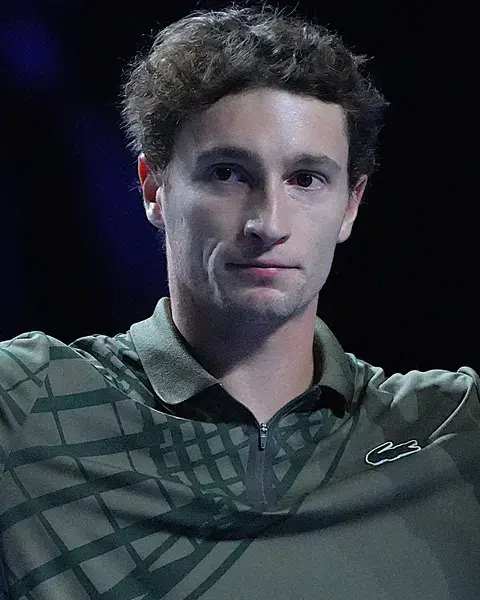 Ugo HumbertFrance · 2018–2026Career-high ranking: 13
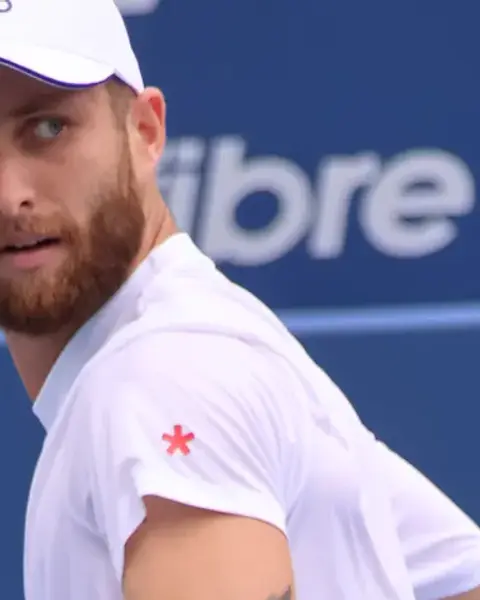 Corentin MoutetFrance · 2018–2026Career-high ranking: 30
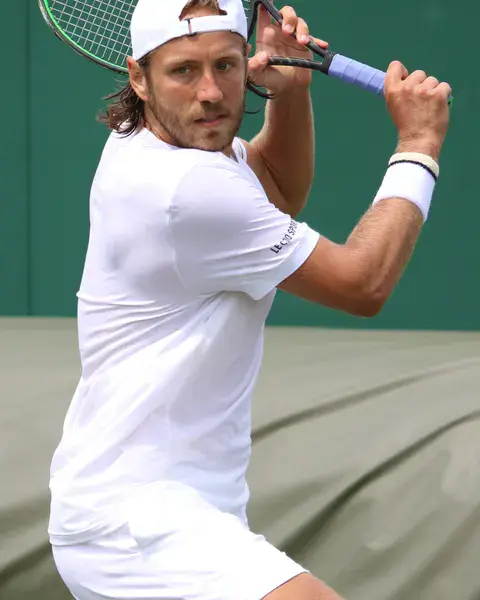 Lucas PouilleFrance · 2013–2025Career-high ranking: 10
TENNIS TENSION LAB
Check your racquet’s tension today.
Get a high-precision tension reading in under 10 seconds. Tension Lab tracks changes from your first reading and helps you see when to restring.
- High-precision tension measurement. Ready in under 10 seconds.
- Track every change in feel. See the full story over time.
- Time to restring? Never leave it to guesswork.