
WTA · Active · Ukraine
Marta Kostyuk
WTA#11Ranking as of 2026-08-24
Career-high ranking: 11
Marta Kostyuk: how a lead survives the next point
Marta Kostyuk is 175 cm tall. Her 2024 Stuttgart wins over Coco Gauff and Markéta Vondroušová show two sides of attacking tennis: rebuilding a lost opportunity and making the next set less costly.
- Status
- Active
- Age
- Age 24
- Height
- 175 cm
- Playing hand
- Right-handed
- Tour wins
- 159 / 276
- Tour titles
- 3
- Grand Slam titles
- 0
- Career win rate
- 57.6%
What changed after the first title
Kostyuk won her first WTA singles title in Austin in 2023. In 2024 she reached the Australian Open quarterfinals and Indian Wells semifinals; in 2026 she won in Rouen and Madrid. Madrid is a WTA 1000 event. The category and draw give those titles context beyond a simple total.
Winning one week can reflect a successful run of attacking tennis. Beating different opponents through successive rounds gives us a reason to examine how that attack holds up. The title count itself does not establish an error rate or quantify improvement in an individual stroke.
Gauff: saving a match point and converting one are different tasks
TENNIS.com’s report of 19 April 2024 records Kostyuk beating Coco Gauff 3–6, 6–4, 7–6(6) in the Stuttgart quarterfinals, in two hours and 44 minutes. The previous day she had saved five match points against Zheng Qinwen. Against Gauff, the challenge was reversed: she needed eight match points of her own to finish. Keeping those two counts separate reveals more than calling both matches dramatic.
In the deciding set, Gauff saved three match points in the tenth game, then served for the match at 6–5. Kostyuk broke back. She led the tiebreak 6–2, lost the next four points, and finally won it 8–6. The 7–6(6) set score therefore contains several changes of control: a chance to finish, a return game that kept her alive, and another chance that had to be rebuilt.
The report describes long rallies at the end, including a Gauff forehand passing shot into the net at 6–6. That matters when reviewing the point: an attacking opportunity can end with the opponent’s error as well as your own winner. Note who had time and balance to attack, and how the reply restricted the next shot. The score identifies the decisive moments; the point sequence explains the choices inside them.
Vondroušová: the next day did not repeat the same match
John Berkok’s 20 April report records a 7–6(2), 6–2 semifinal win over Markéta Vondroušová. Kostyuk’s early 5–1 lead disappeared, yet she recovered to take the opening tiebreak 7–2 and the second set 6–2. It was her third top-10 win in three days, following Zheng and Gauff. The closing set gives this match a different shape from the previous day’s deciding-set escape.
For a useful comparison, start at the moment the lead vanished and follow the next service and return games. Did the hitter still have room to change direction, and could she cover the reply? A big lead can disappear while some patterns remain effective; abandoning all of them because the score tightened would miss that distinction. Kostyuk finished the tournament as runner-up to Elena Rybakina, so this semifinal belongs within a complete run rather than a title-winning account.
Judge an attacking shot by the recovery that follows
Kostyuk plays right-handed with a two-handed backhand. After an aggressive shot, watch how quickly she reaches a position from which to cover the reply. A hard shot can still leave its hitter with a long recovery, allowing control of the point to change.
The ball after a down-the-line change is particularly revealing. Assess how far the change moved the opponent and whether the hitter recovered towards the middle of the opponent’s available angles. These are viewing criteria, rather than a substitute for measured tracking data.
Practise closing a lead without changing every decision
Play service games starting at 40–15, alternating server with a partner. Before each game, choose a serve target and the condition that allows an attacking change of direction—for example, a short reply that you can meet in balance. If the lead disappears, keep the target unless the receiver has given you a reason to change it. Record the decision and court position after the attack, not just whether the game was won.
After ten games, compare the points played while ahead with those played after deuce. Look for attacks attempted from worse balance, late recovery or a return position that made the original serve target less useful. Change the specific choice that failed. This is a suggested club exercise drawn from the Stuttgart cases, not Kostyuk’s documented training routine.
Results by surface
Read each win rate together with its recorded match sample.
- Hard
- 58.1%179 matches
- Clay
- 62.3%69 matches
- Grass
- 40.0%25 matches
Career timeline by age
· Age 15
First recorded tour match
The first main-draw tour match covered by the current data set.· Age 20
First tour title
A verified tour-title milestone in this player’s career.· Age 23
Most recent recorded match
The latest tour match included in the current snapshot.· Age 24
Career-high ranking: No. 11
The highest position found in the available weekly singles rankings.
Reviewed sources
A result-based profile built from surface results, rankings, titles, and playing hand. Missing shot-speed, spin-rate, and point-pattern data are not invented.
Player reference page ↗Players to explore next
 Dayana YastremskaUkraine · 2016–2026Career-high ranking: 21
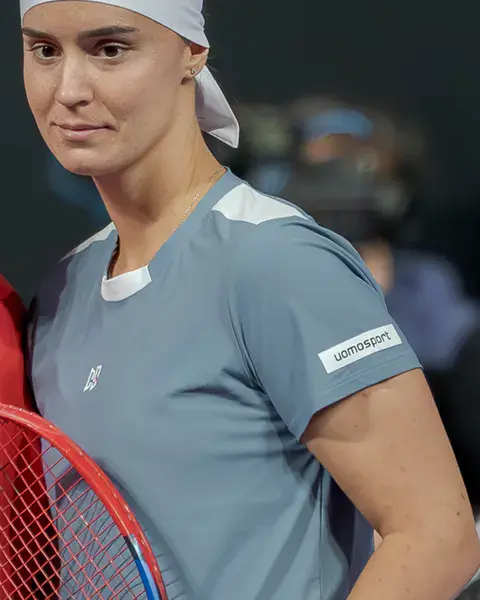 Anhelina KalininaUkraine · 2015–2026Career-high ranking: 25
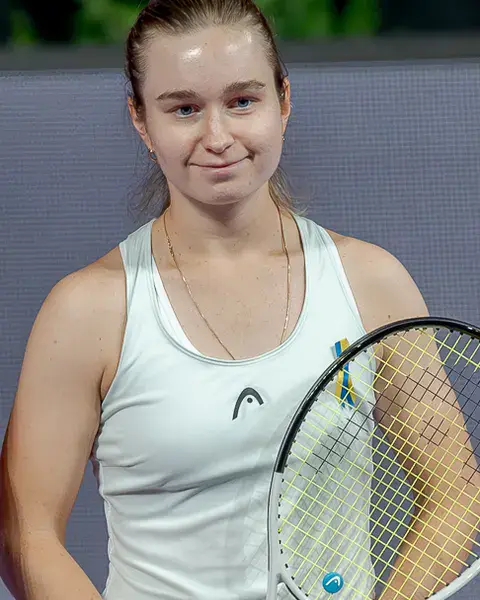 Daria SnigurUkraine · 2022–2026Career-high ranking: 43
 Elina SvitolinaUkraine · 2012–2026Career-high ranking: 3
 Yuliia StarodubtsevaUkraine · 2024–2026Career-high ranking: 53
 Oleksandra OliynykovaUkraine · 2026–2026Career-high ranking: 51
TENNIS TENSION LAB
Check your racquet’s tension today.
Get a high-precision tension reading in under 10 seconds. Tension Lab tracks changes from your first reading and helps you see when to restring.
- High-precision tension measurement. Ready in under 10 seconds.
- Track every change in feel. See the full story over time.
- Time to restring? Never leave it to guesswork.